Amazon's Ring will sell a $250 indoor security drone that is loud on purpose
After ten years of false starts, Ring's indoor security drone ships in January, steered by a cloud 'AI Pilot', next to a $1,000 rolling robot for offices and warehouses.
In brief
Ring's $250 home drone ships January 27 and records only while it is flying
Amazon's Ring will ship a $250 flying indoor security camera on January 27. A cloud AI Pilot steers it to any room you tap in the app. It records only while flying and is deliberately noisy, so it can't sneak up on anyone.
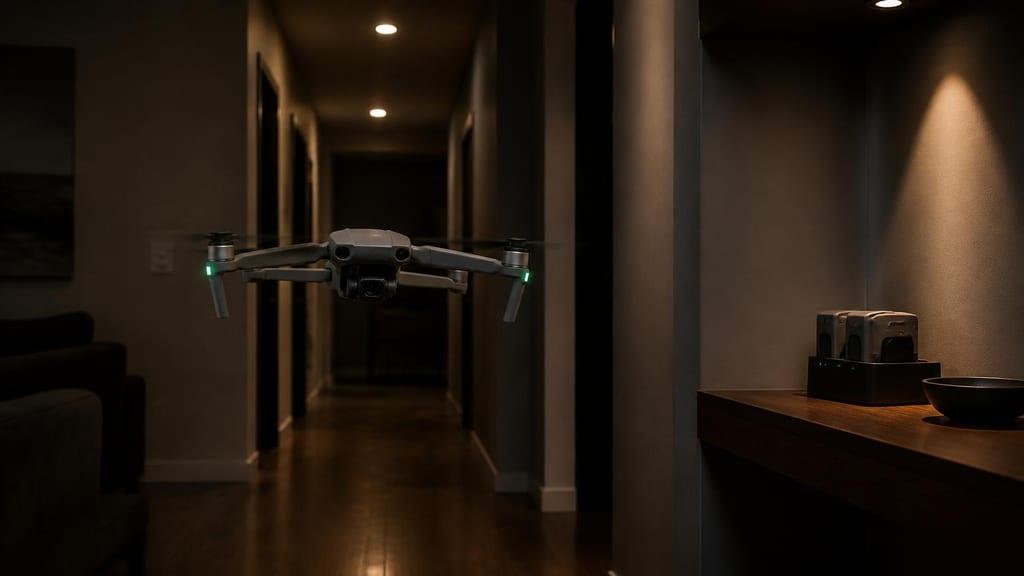
Ring, the Amazon-owned doorbell company, is finally selling the flying indoor camera it first showed off back in 2020. The Ring Drone Cam costs $249.99, is up for preorder now and ships on January 27, 2027. It has a sibling: the Ring Rover Cam, a $999 rolling security robot for workplaces that ships first, on December 16, 2026. Both sit under a new brand called Ring Robotics.
What the drone does
It's loud — we think that's a feature. This thing is not gonna sneak up on you.
The Drone Cam is a small quadcopter, about 160 grams according to TechRadar, with a 2K camera and two LED spotlights. It sits on a charging dock. When one of your Ring sensors notices something, say a back door left open, you tap that spot on a map of your home in the Ring app. The drone takes off, flies there and shows you a live view. You can also schedule patrols, including across floors, because it can follow a staircase.
Flights are short. The Shortcut reports five to eight minutes in the air, with roughly eight minutes of charging for every minute of flying.
The trick: the brain lives in the cloud
Ring's earlier drones kept stalling because every extra sensor and chip made them heavier. Heavier meant bigger rotors, more power and, CEO Jamie Siminoff told Engadget, a price that could have passed $5,000. This time Ring moved the thinking to its servers. A cloud system it calls AI Pilot maps the home, suggests patrol points and steers around obstacles. The drone itself mostly knows how to stay on Wi-Fi and land.
That has a cost. If your internet drops, TechRadar reports, the drone simply lands where it is, if it's safe to do so. Siminoff also admitted it isn't clever enough to plan a new route around something like a group of people blocking a hallway.
A camera that can fly into any room
A flying camera inside the house is an obvious privacy worry, and Ring's past dealings with police video requests don't help. Ring's answers: the drone records only while it is flying, turns its camera off when docked, and has no microphone or speaker. It is also noisy by design.
It's loud — we think that's a feature. This thing is not gonna sneak up on you.
That was Siminoff speaking to TechRadar. The idea is that nobody, including a hacker who got into your account, can quietly fly it around while you're home.
The Rover Cam is Astro's second life
The $999 Rover Cam reuses much of the hardware from Astro, the home robot Amazon discontinued in 2024. It has a 4K camera on a periscope that rises to see over counters and shelves, a siren, two-way talk, and a light it beams onto the ceiling so staff can spot where it is. Ring says it covers up to 5,000 square feet and patrols for about 30 minutes before heading back to its dock.
Is it worth it?
For most homes, a couple of fixed cameras still do the job for less. The drone makes the most sense for people who don't want a camera in every room. Ring's product page also says it doesn't ship to Canada, and it works indoors only. The real test starts in January: whether a drone steered from the cloud copes with ordinary home Wi-Fi, and whether buyers are willing to give Amazon a camera that can go anywhere in the house.
Sources
- Engadget: Amazon finally launches the $250 Ring Drone Cam and also the Ring Rover Cam (engadget.com)
- TechRadar: Ring CEO Jamie Siminoff on why Ring Drone Cam's sound is intentional (techradar.com)
- The Shortcut: Amazon Ring Drone Camera is a $250 flying security bot (theshortcut.com)
- Ring: Drone Cam product page (ring.com)
Source: engadget.com