Dharma Field Extractor, a 2-billion-parameter model, scored 0.834 and beat four frontier models at pulling fields from documents
Dharma-AI says its small model runs on one L40S GPU and costs 6 to 147 times less per extraction than the frontier APIs it was tested against.
In brief
A small model beat four frontier AIs at reading forms
Dharma-AI's Field Extractor scored 0.834 on its own benchmark. Claude Opus 5 got 0.816. The company says it costs 6 to 147 times less per extraction.
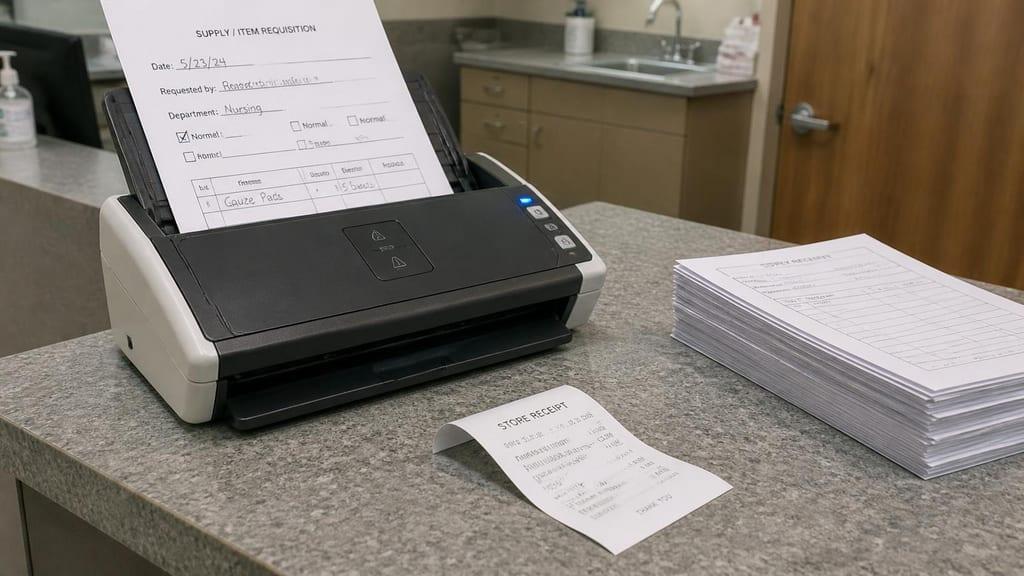
A small model with 2 billion parameters has outscored four frontier AI configurations at pulling named fields out of documents. Dharma-AI, the company behind it, says the Field Extractor scored 0.834 on a benchmark it designed and ran itself. The company announced the model on the Hugging Face blog.
The results
The benchmark has 546 documents and 1,638 cases across three scenarios: no schema, a partial schema, and a schema with deliberately fake fields. The score combines field-level F1, text similarity on matched values and the share of valid JSON.
Claude Opus 5, the closest rival, scored 0.816. GPT-5.6 Luna scored 0.741. Four frontier configurations were tested, all with reasoning set to low.
On cost, the company reports figures from 6 times lower (against GPT-5.6 Luna) to about 147 times lower (against GPT-5.6 Sol). For its own model, it counts the hourly rental of one L40S GPU, priced at $2.24.
Two public datasets, SROIE and FUNSD, were held out of training. On one SROIE receipt, all 18 fields came back correct. On one FUNSD form, the model marked the single checked box correctly among twelve.
What the model does
Think of a clinic that receives scanned requisitions and needs only the patient name and exam date for its scheduler. Plain OCR returns every line printed on the page and leaves it unclear which string is which. Someone must then write code to sort the values.
The Field Extractor reads a document image and returns just the requested fields as structured JSON. It can be asked in two ways:
- Open: no schema is given. The model finds labels with values and tables on its own, and returns key-value pairs.
- Schema-directed: you list the fields, each with a type (string, number or boolean), under your own key names. The output follows that shape exactly, with no extra fields.
When a requested field is missing from the document, the model returns null rather than inventing a value. Dharma-AI says a single checkpoint covers all document types without separate fine-tuning for each.
How it was built
The starting point is DharmaOCR-LITE v1.1, a 2-billion-parameter model already tuned for OCR. Dharma-AI added a LoRA adapter, a small add-on layer, trained on 43,384 examples. Training material came from three groups: English documents gathered from the public web, real Brazilian documents in Portuguese, and a smaller set in other European and Asian languages.
Limits
The benchmark and the comparison are Dharma-AI's own. The company says the cost figure is not a sales price, because self-hosted cost depends on hardware, volume and the speed a deployment needs. The two sides are also priced differently: per-token list prices for the APIs, GPU hours for Dharma. The source gives no independent test.
Source: Hugging Face Blog