GPT-6 Astra scored 66.7% on OpenAI's new test of reading raw lab evidence
OpenAI and the biotech firm Ligo built BioBasicsBench, 100 tasks on gel images, colony plates and microscopy, and the best model still made clear errors.
In brief
AI read lab evidence and got 66.7%
OpenAI and Ligo tested seven models on 100 wet-lab tasks. GPT-6 Astra led with 66.7% partial credit. Errors remain, including a 12% colony overcount.
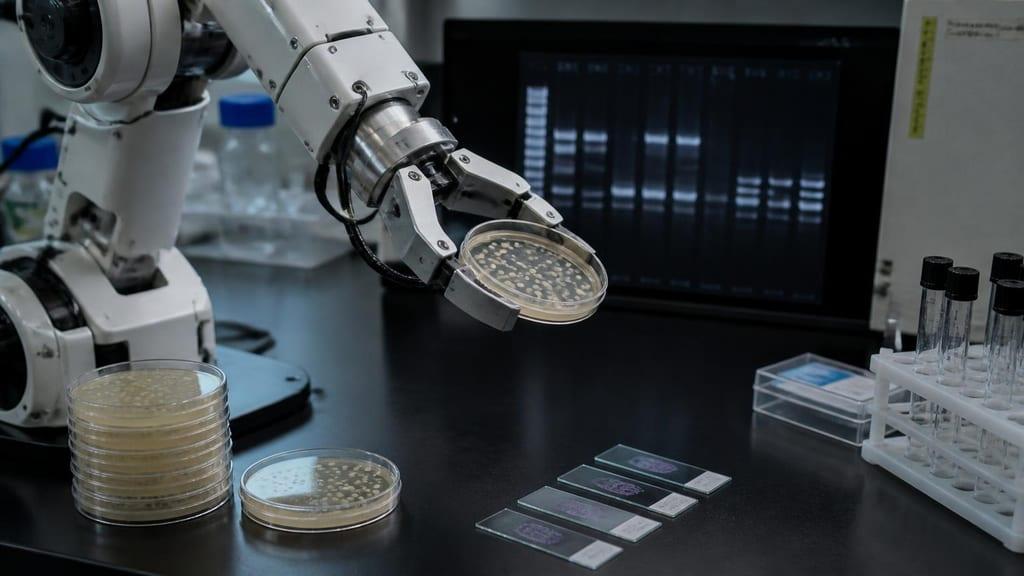
OpenAI and Ligo, a biotech company focused on enzyme design, have released BioBasicsBench. It is a benchmark of 100 tasks that tests how AI agents read raw evidence from wet-lab experiments. We know this from OpenAI's post, which the page dates November 6, 2026, and from specialist AI news sites.
One report says the benchmark was announced on November 4 instead. The sources disagree on that date.
What the tasks look like
The agents get real lab material: gel images, colony plates, microscopy and instrument readouts. The tasks fall into five areas: protein methods, imaging and cytometry, quantification and assays, nucleic acid methods, and molecular cloning.
A Ligo scientist who did not write a task checked it. So did an external PhD-level wet-lab scientist, and then a final internal review.
The numbers
OpenAI tested seven models, including GPT-5.6 Sol, GPT-6.1 Sol and GPT-6 Astra. It ran 37 combinations of model and reasoning effort, with five attempts per task.
At the highest reasoning setting, GPT-6 Astra averaged 66.7% of the available credit. GPT-5.6 Sol averaged 43.8%.
Scoring gives partial credit against rubrics written by experts. So 66.7% is not the share of experiments the model would get right.
Why it matters
Imagine a lab assistant who looks at a photo of a plate and tells you what to do next. If it misreads the photo, you lose days. This test checks that step: reading the evidence before deciding.
The failures OpenAI documents show the risk. One was a 12% overcount of colonies. In another, a colony PCR task, the leading model picked the wrong samples.
Limits
OpenAI says higher scores do not yet mean models make reliable lab judgments. It tested only its own models, and the benchmark has no human baseline. The sources do not say how a trained scientist would score on the same tasks.
Sources
Source: OpenAI News