Google says teams of AI agents helped tackle a math problem posed in 2013
The company says its Antigravity teamwork system helped researchers formalize a proof in a computer-checkable language.
In brief
Google says its AI agents helped humans formalize a math proof of about 50 million lines
Google says human researchers worked with teams of AI agents, using its Antigravity system, on a math problem first posed in 2013. Together they wrote the proof in a language a computer can check, and it spans about 50 million lines.
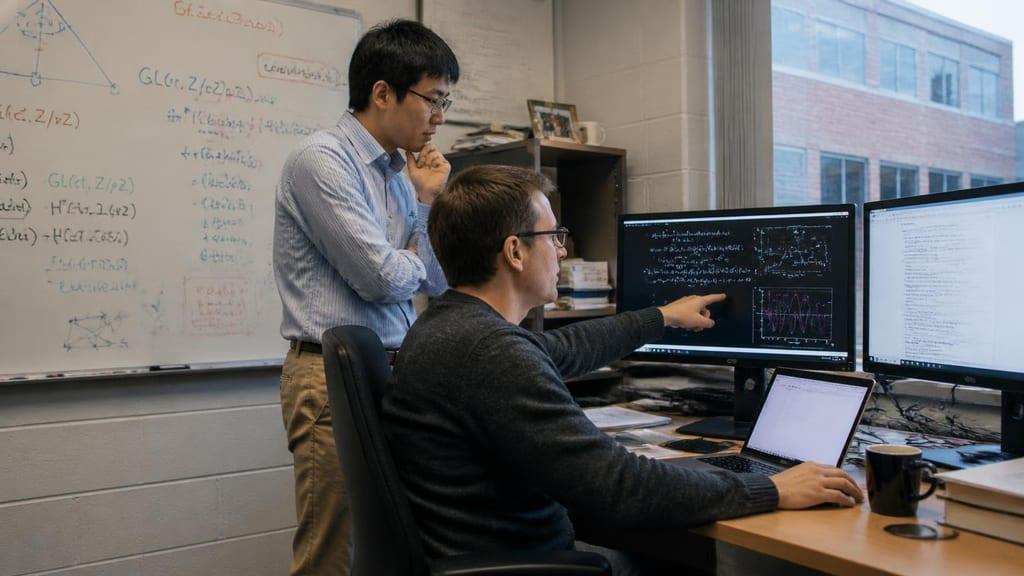
Google Research says a collaboration between scientists and AI agents has produced a proof of a question posed in 2013 about how information survives a noisy communication channel. The work involved researchers from Google and universities, and the proof was formalized in about 50 million lines of Lean 4 code, the company says.
The problem, known as the Courtade–Kumar conjecture, concerns how much information about a random string can be kept when it is compressed to a single bit and sent through a noisy channel. The proposed answer says copying a single input bit is as good as any such compression.
Google describes a substantial human role. Researchers at the Chinese University of Hong Kong proposed a candidate function and an analytical bound after Gemini found counterexamples to an earlier generalized claim. The AI systems then developed much of the subsequent mathematical work, Google says.
A separate system formalized the Weil conjectures in around 1.8 million lines of Lean. That was not a new solution: Pierre Deligne's proof dates to 1974. Formalization expresses an existing argument so a computer can check its logical steps.
A proof checker is powerful, but people must still check that the formal statement matches the original mathematical problem. Google says teamwork workflows are available in Antigravity, with more features for outside users planned in coming weeks.
Sources
Source: research.google