1,000 Claude agents rebuilt the proof of Fermat's Last Theorem in 30 hours
Anthropic's new Claude Fable 5.2 and Mythos 5.2 are cheaper and faster than the last versions, and the company opened with a math record set by its own agents.
In brief
Anthropic's new Claude Fable 5.2 cut a proof job from 11 days to about 30 hours
A team of 1,000 Claude Fable 5.2 agents rewrote the proof of Fermat's Last Theorem in computer-checkable code in about 30 hours, a job that took 11 days in September. Anthropic's new Claude models, Fable 5.2 and Mythos 5.2, are also cheaper, at $8 per million input tokens.
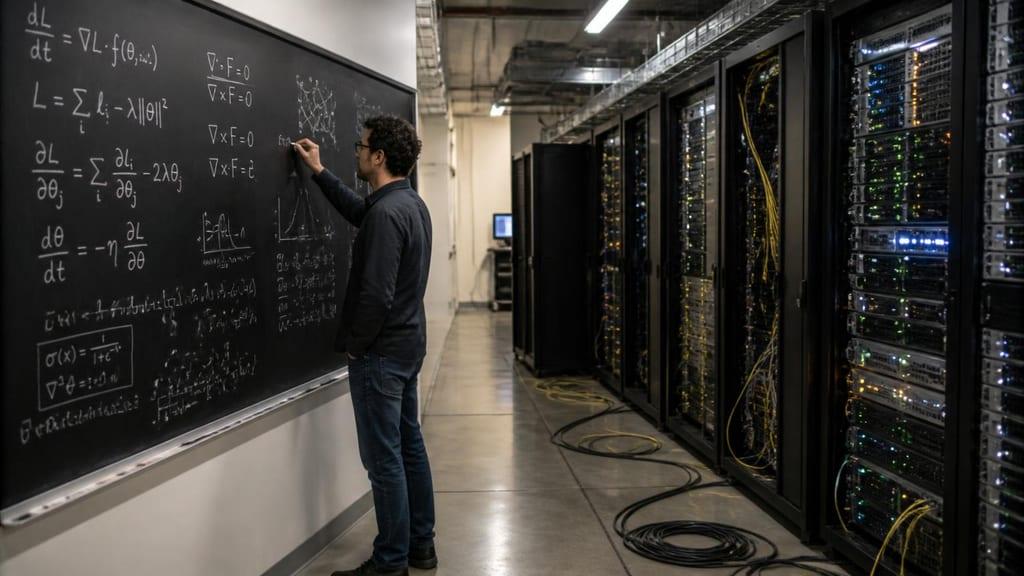
Anthropic released Claude Fable 5.2 and Claude Mythos 5.2 on Monday and led with a math stunt. A team of 1,000 Fable 5.2 agents turned the proof of Fermat's Last Theorem into code that a computer can check line by line, in about 30 hours. Anthropic's first attempt, published in September, took 11 days.
What happened with Fermat
Over 90% of the changes merged into Anthropic's core codebase are now written by Claude (with human guidance).
Nothing new was proved here. Fermat's Last Theorem was proved by the mathematician Andrew Wiles in the 1990s. The hard part is formalizing it: rewriting the whole proof in Lean, a programming language in which a computer checks every single step.
In September, Anthropic said a researcher and dozens of agents running an internal model needed 11 days and about 6 billion output tokens for that job, writing 13 million lines of Lean. This time, according to Anthropic's developer blog, 1,000 agents running an early version of Fable 5.2 finished in 28.7 hours without a researcher steering them. They used a third as many tokens and produced a proof one-seventh as long.
It was not a blank page. The agents got a list of 60 statements to prove, a one-sentence sketch of the classic route, the definitions they needed and 47 lemmas already proved in the earlier run. Each agent worked in a sandbox with no internet access, and a classifier checked every command before it ran. Anthropic calls it a toy experiment. With the same setup, its Opus 5.5 model completed only 26% of the job in 18 hours.
Cheaper, faster, and in two versions
Fable 5.2 and Mythos 5.2 cost $8 per million input tokens and $40 per million output tokens, down from $10 and $50 for the 5.1 versions. An optional fast mode costs $16 and $80. Anthropic says the new models produce output up to 30% faster than 5.1.
Fable and Mythos are the same underlying model. Fable carries extra safeguards for cybersecurity and biology and is open to all users. Mythos drops those blocks and is only for organizations that pass Anthropic's verification programs for cyber defense and life sciences.
The company also made a striking claim about itself:
Over 90% of the changes merged into Anthropic's core codebase are now written by Claude (with human guidance).
In another internal test, one engineer asked Fable 5.2 to design a prototype operating system. Starting from an empty folder, it coordinated more than 1,000 subagents for eight days and produced a system that boots on a laptop.
Should you switch?
Probably not for everyday work. Anthropic itself recommends starting with Opus 5.5 for most coding and knowledge tasks and moving up to Fable only for the biggest open-ended technical projects. Every result above comes from Anthropic's own testing, so independent benchmarks over the next few weeks will show how much of the jump holds up.
Sources
In this story
Source: anthropic.com