Volvo starts training humanoid robots for real car production from mid-2027
Two wheeled AEON robots are learning their first task in Ghent, Belgium, by copying how workers place parts into fixtures.
In brief
Volvo is training humanoid robots to work in its Ghent car plant from mid-2027
Volvo Cars has started training AEON humanoid robots, made by Hexagon, at its plant in Ghent, Belgium. Their first task is placing parts into fixtures, learned by copying people. A bigger pilot follows in early 2027, and Volvo wants them in real production from mid-2027.
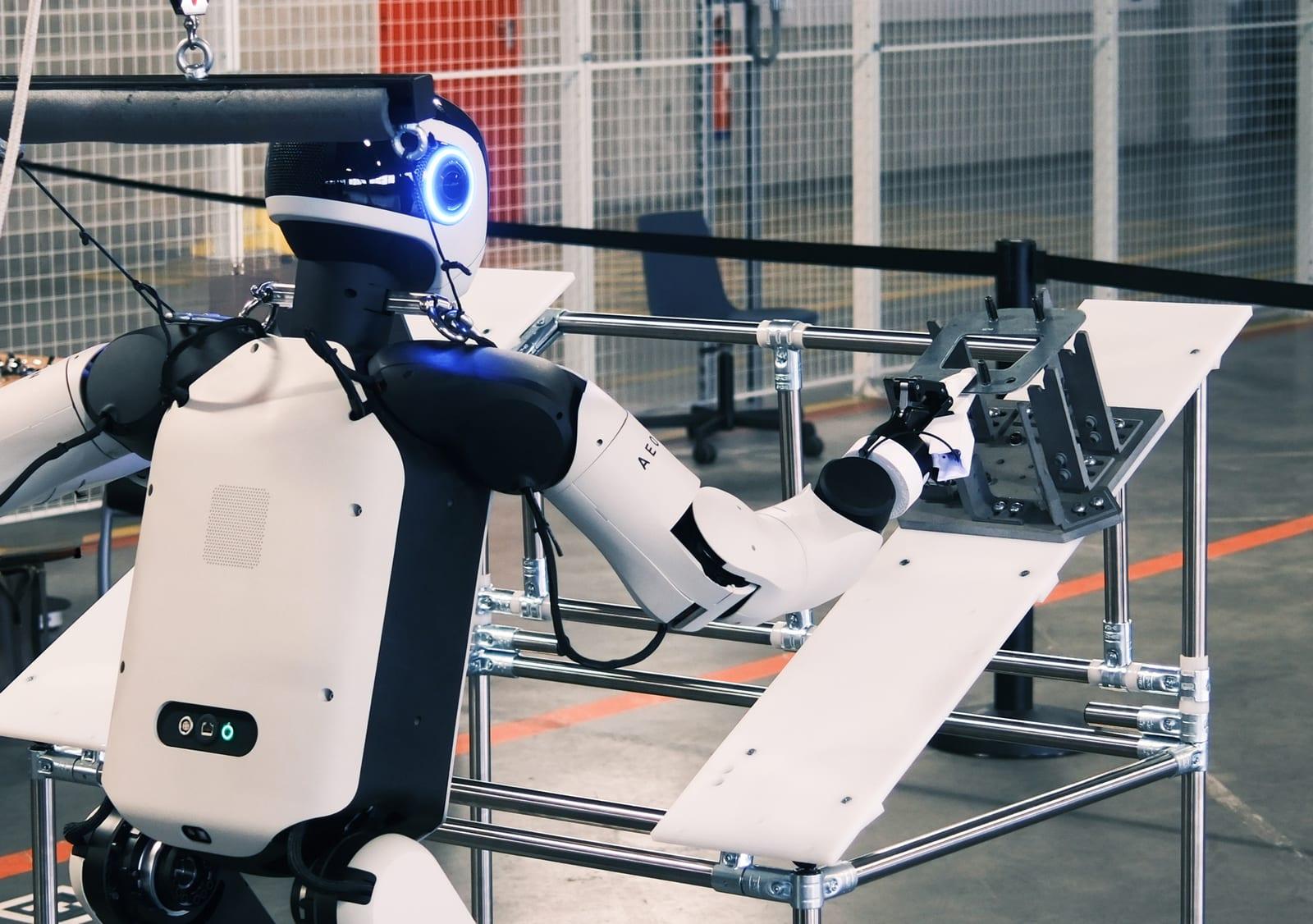
Volvo Cars has put humanoid robots on the floor of its car plant in Ghent, Belgium, and their first lesson is a single job: placing parts into two fixtures with high precision. The carmaker announced on November 26 that it is training AEON robots, made by the robotics division of the Swedish technology group Hexagon, and aims to have them doing real production work from mid-2027.
Ghent is the first Volvo plant to try humanoids. Belgium's public broadcaster VRT reports that two of the robots are being trained there now. A larger factory pilot follows in the first half of 2027, when more AEON units will arrive to take on a wider range of tasks, Volvo says.
Our aim is for humanoid robots to take on some of the most physically demanding tasks and help make work more ergonomic for our people.
How do you teach a robot a factory job?
By showing it. Volvo's own team, working with Hexagon, uses imitation learning: the robot learns a task by copying how a person does it. Once one step is proven, the team plans to make the work harder, with several different parts, moving around the production area and working with the plant's automated systems.
The robot itself is 1.65 meters tall and weighs 60 kilograms, according to Volvo. It sees with cameras and sensors, carries up to 10 kilograms, and moves on wheels instead of feet at up to 2.4 meters per second, which Volvo describes as about the pace of a light jog. So it is a humanoid from the waist up. For a flat factory floor, that is a practical choice.
| AEON at a glance | |
|---|---|
| Height | 1.65 m |
| Weight | 60 kg |
| Payload | up to 10 kg |
| Top speed | 2.4 m/s, on wheels |
| First task | placing components into two fixtures |
| Next step | factory pilot, first half of 2027 |
| Goal | real production work from mid-2027 |
Why the human shape?
Car factories have used robot arms for a long time. Volvo's argument is that fixed arms are excellent at the same task in the same spot, but some tiring jobs need a machine that can move and reach like a worker. "AEON's humanoid design means it can fit into our production as it is today, alongside our teams and existing automation," said Magnus Nilsson, Volvo Cars' chief manufacturing officer. "Our aim is for humanoid robots to take on some of the most physically demanding tasks and help make work more ergonomic for our people."
Volvo spokesperson Barbara Blomme told VRT that the plan is not to replace staff but to make production more efficient and hand over the more physically demanding tasks. She said workers had already met the robots, and added that it would be strange for a carmaker not to work with such robots, since they are already common in China. If the project works, Volvo wants to add more humanoids gradually, VRT reports.
What Volvo has not said
The announcement leaves out the numbers that would show whether this works. Volvo gives no accuracy or uptime target for the pilot, no cost and no figure for how many robots "more" means, Tech Times points out. The same report notes that imitation learning has a known weak spot: a robot trained on demonstrations can struggle with situations nobody showed it, which is exactly what each harder step will bring. A new EU machinery regulation also starts to apply on January 20, 2027, in the middle of the pilot.
For now, nothing in Ghent counts as production. As Motor1 puts it, this is training and validation.
What it means for you
If you do not work in a car plant, nothing changes yet. What is new is that a big European carmaker has put dates on humanoids doing real work, and named the jobs it wants them to take: the repetitive, physically hard ones. If you do work on an assembly line, the mid-2027 pilot is the moment to watch, because that is when Volvo will have to show how many robots it brings in and what they actually do.
Sources
- Volvo Cars: Volvo Cars trains Hexagon Robotics' humanoids for manufacturing (November 26, 2026) (volvocars.com)
- Hexagon Robotics: Volvo Cars trains AEON humanoid robots for manufacturing (robotics.hexagon.com)
- VRT NWS: Volvo laat mensachtige robots zwaar werk overnemen in Gent (vrt.be)
- Tech Times: Volvo Humanoid Robots Begin Ghent Training With One Task (techtimes.com)
- Motor1: Volvo Humanoid Robots Begin Training In Ghent Factory (motor1.com)
Source: volvocars.com