Boston Dynamics put wheels on Atlas and it landed a 360-degree spin jump on the first try
The wheeled humanoid is a research testbed, not a product. It shows how robots trained in simulation are getting better at working in the real world.
In brief
Boston Dynamics swapped Atlas's feet for wheels to push the robot's motors to the limit
Boston Dynamics swapped the feet of its Atlas humanoid robot for wheels to push its motors to the limit. Trained in a simulator, it drifted, dashed sideways and landed a mid-air 360-degree spin on its first try. The company says it is a research test, not a product.
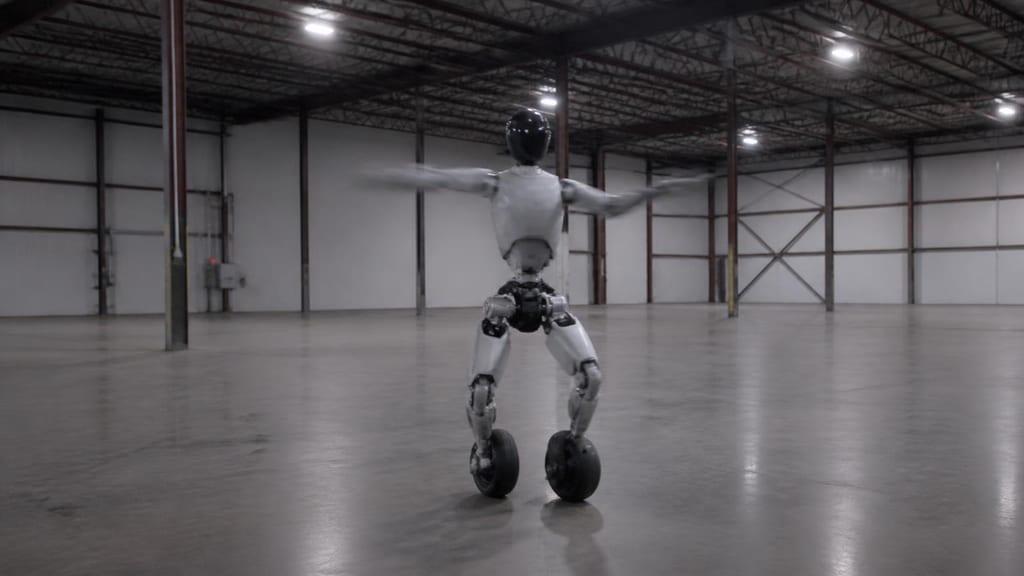
Boston Dynamics released a video on Monday of its Atlas humanoid robot with wheels where its feet would be. In it, Atlas rolls, drifts, dashes sideways, balances on one wheel with the other leg lifted, gets up from the ground by itself, and lands a 360-degree spin jump, turning once in the air like a figure skater.
Why put wheels on a walking robot?
It just worked first try.
It is a stress test. Boston Dynamics, which is owned by Hyundai Motor Group, says the wheeled Atlas is a research platform for checking how its motors and whole-body control software behave at the edge of their limits. Starting, turning and stopping on wheels puts heavy, fast loads on the motors, which makes it a good way to find problems. The company says it has no plans to sell a wheeled version.
Trained in a simulator, right first time
The moves were learned with reinforcement learning, where the robot practises again and again in a computer simulation and keeps what works. The hard part is making those skills work on real hardware, so the team modelled how the actual motors behave in the simulator as closely as possible.
The spin jump started as motion-capture data of a person doing a jumping 360. Controls engineer Andy Woo explains in the video that the team ran its training pipeline on top of that recording, and then:
It just worked first try.
He also says the training found its own way to use the wheels during the side dashes, rolling instead of sliding, which surprised the team. He compared driving the robot to playing a video game.
What it means
You will not see a wheeled Atlas in a shop or warehouse soon. What matters is the method. Each time a skill learned in simulation works on a real robot the first time, it gets cheaper and safer to teach robots new jobs, because fewer real machines get broken in practice.
Sources
Source: youtube.com