NVIDIA software accelerated semiconductor simulation times by up to 35 times
New physics-based AI tools help engineers cut down design cycles and optimize chip manufacturing processes.
In brief
NVIDIA AI accelerates chip design by 35x
Engineers are using physics-based AI to simulate semiconductor manufacturing. This method creates **faster design cycles** and **reduces expensive trial runs** by testing in a virtual environment.
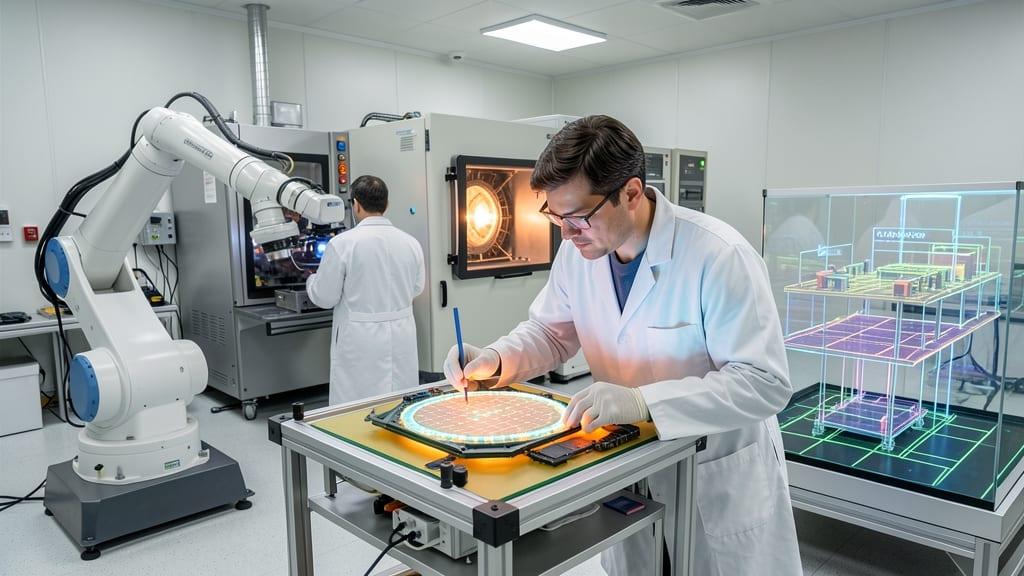
Engineers are now using physics-based AI to overhaul how semiconductor factories, or fabs, operate. Advanced chip manufacturing involves complex steps where even small errors lead to expensive mistakes. Researchers can now use accelerated computing to test virtual prototypes before building them physically.
Simulations that previously took days are finishing in hours or even milliseconds. For instance, the cuDSS library is helping companies like COMSOL speed up multiphysics modeling by 10 times. These simulations predict how heat, stress, and electrical currents interact within a device.
The future of semiconductor manufacturing lies in connecting these capabilities: using production data to inform models and models to evaluate changes.
Applied Materials has integrated NVIDIA tools to advance its own platforms. Its ACE+ software now performs topography simulations up to 35 times faster than before. Meanwhile, the cuLitho platform helps Siemens handle massive calculations needed to print circuit patterns on silicon.
Beyond just speed, AI is changing the nature of the work. The PhysicsNeMo framework allows engineers to predict the behavior of plasma used in etching processes in mere milliseconds. This means they can explore far more design variations without running slow, full-scale simulations.
AI agents are also stepping in to handle tedious administrative tasks. Advantest now uses NeMo Switchyard agents to choose which AI models to apply to a specific task, cutting a manual process from hours to minutes.
Digital twins are creating virtual replicas of entire factory floors. By using Omniverse, teams can simulate how materials move and identify potential bottlenecks before the actual machines are even set up. It is like a flight simulator for a billion-dollar factory floor.
Engineers remain in charge of the final decisions. They use these tools to interpret data and verify changes faster than ever before. Have you ever wondered how many failed prototypes it takes to make the chip in your phone?
These tools are not a magic solution that removes human oversight. The source does not specify how these systems perform when dealing with entirely new, non-standard materials or how they scale across different global factory infrastructures.
Source: NVIDIA Blog