Nvidia says its GR00T 2 robot brain gets a task right 71% of the time after one demo
GR00T 2, unveiled at the Conference on Robot Learning, picks up hand skills like plugging in cables from one or a few demonstrations. Nvidia says five demos push success to 95%.
In brief
Nvidia trained its GR00T 2 robot model on 100,000 hours of video of human hands
Nvidia's GR00T 2, shown at the Conference on Robot Learning, averaged 71% success on 50 delicate tasks after seeing each one once, and 95% after five demos. It learned partly from 100,000 hours of people's hands on video. All results are Nvidia's own tests.
Teaching a robot a new job with its hands usually takes hundreds of demonstrations. Nvidia says its new model needs one.
At the Conference on Robot Learning (CoRL) in Austin on November 9, Nvidia introduced GR00T 2, which it calls an open "world action model". It's the kind of AI that sits inside a robot and decides how to move, built on Nvidia's Cosmos world models.
The numbers
Nvidia tested GR00T 2 on 50 tasks involving careful hand work:
- With no task-specific demonstrations, it completed 40 of the 50 tasks at least once.
- With one demonstration per task, it averaged 71% success.
- With five, it averaged 95%.
It also ranks in the top three on several public robot benchmarks, including RoboCasa365, RoboLab, RoboDojo and MolmoSpaces, according to Nvidia.
Why human video matters
The interesting part is how it learned. Alongside robot data, GR00T 2 was trained on 100,000 hours of first-person video of people doing things with their hands, a dataset Nvidia has released openly. Robot training data is slow and costly to collect. Video of humans is not. Nvidia says GR00T 2 can learn from human demonstrations and transfer a skill from one robot body to another without needing that robot to be shown first.
It also has an interface that lets AI agents call its skills one after another and recover when something goes wrong, so a software agent could direct a robot through a longer job.
Training in simulation
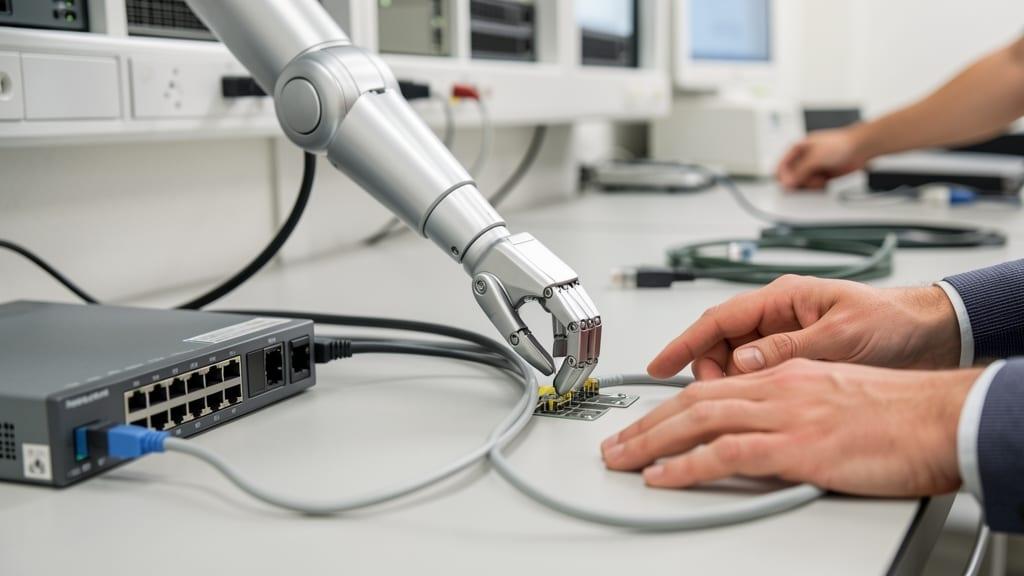
Nvidia also released Isaac Lab 3.0, its open source software for training robots in simulation. It can now model floppy things like cables and cloth and hands with many joints, and Nvidia says it trains up to 2.5 times faster than the previous version on a dexterous hand benchmark. One partner, MicroAGI, is using GR00T 2 plus this setup to teach a robot arm to swap Ethernet cables, the kind of fiddly task that's still hard for machines.
What to keep in mind
Every result here is from Nvidia's own testing. "71% success" also means the robot fails almost three times in ten after one demo, which is fine in a lab and not fine on a factory line. Nvidia calls GR00T 2 open, but its announcement didn't include a model card, license or download link, so it's not yet clear how freely people can use it.
The direction is clear, though. If robots can learn from watching people instead of being painstakingly programmed or shown a task hundreds of times, the cost of teaching them new work drops a lot. That matters for the warehouse and factory jobs where these arms are headed first.
Sources
- NVIDIA Blog: At CoRL, NVIDIA and partners reveal how robots rehearse delicate work in simulation (blogs.nvidia.com)
- The Robot Report: NVIDIA launches GR00T 2 and Isaac Lab 3.0 at CoRL (therobotreport.com)
- NVIDIA Research: GR00T 2 (research.nvidia.com)
- CellCog: NVIDIA GR00T 2 and Isaac Lab 3.0 at CoRL 2026 (cellcog.ai)
Source: blogs.nvidia.com