Two small AI models taught each other to predict language, music and DNA with zero training data
Tel Aviv University and Stanford built the proof of concept, and its predictions improved as the training used more computing power.
In brief
AI learned to predict with zero training data
Two small models trained each other. One wrote programs, the other predicted the output. Tested on language, music and DNA, **predictions improved with more compute**. It **cannot teach real-world facts** alone.
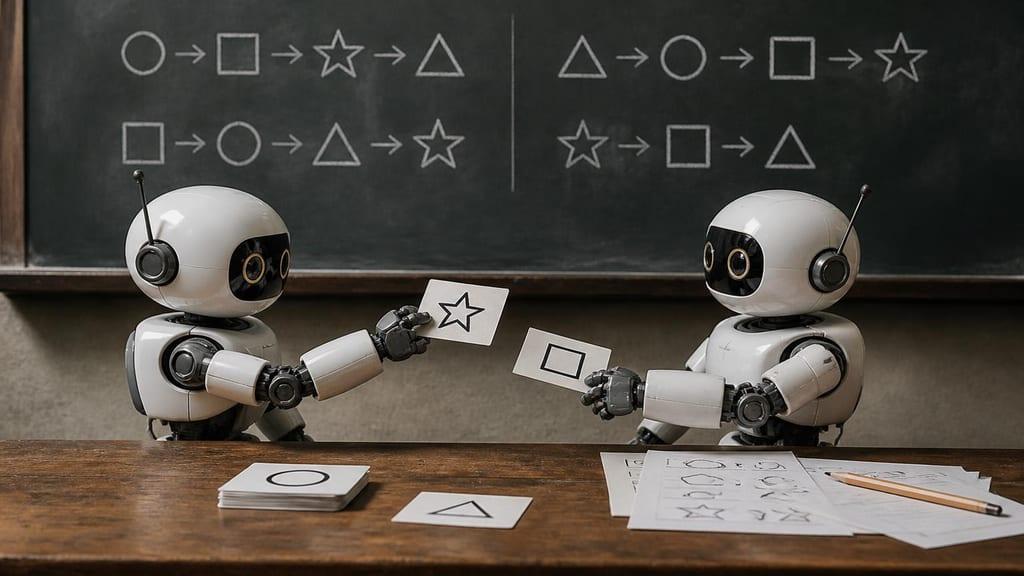
Two small AI models have learned to predict the next piece of a sequence without ever seeing real-world data. The work comes from Tel Aviv University and Stanford University, and it is described in a paper on the arXiv preprint site.
How it works
The setup is a duet. One model writes small programs, and each program outputs a sequence of symbols. The other model, the learner, tries to guess the next symbol.
The writer is rewarded for producing sequences at the edge of what the learner can handle. As the learner improves, the exercises get harder. The authors call this an adaptive curriculum.
Imagine a tutor who sets each new quiz just above your current level. This is the same idea, with no human writing the questions.
What was tested
After training, the models were tested on language, images, sound, music, computer code and DNA sequences. None of those were used in training. The abstract calls this a clean test of transfer.
The result: prediction improved in a steady, predictable way as more computing power went into training. The abstract also says the models showed in-context learning, meaning they picked up patterns from examples given at the moment of use. They also discovered recognizable mathematical sequences along the way.
Who did it
Dr. Yoav Levine of Tel Aviv University supervised the work. Dr. Kfir Dolev carried it out as part of his postdoctoral research. The other authors are Aditya Cowsik, Michael Y. Li, G. Bruno De Luca, Nourya Cohen and Noah D. Goodman.
Tel Aviv University announced the work in a statement on Wednesday, November 4, 2026. The arXiv record shows the paper was submitted on 24 September 2026, so the study had been online for about six weeks before the coverage.
Why it matters
Today's top models learn from enormous piles of human-made text and images, which are curated for them. The authors argue that a model able to produce its own useful training material would be limited by computing power, not by human knowledge.
Some news outlets, including Ynetnews and The Media Line, describe this broadly as models teaching themselves. Levine and the arXiv abstract use narrower words: a small-model proof of concept. Some coverage also says the data was made from scratch or by other AI models, which is looser than the paper's wording of programs run on a universal Turing machine, a theoretical computer that can run any program.
The researchers say the method cannot teach facts about the real world without exposure to real-world information. They say it may help future systems learn more efficiently once they meet real data. The tests so far involve small models, and the paper calls it an initial step.