An AI detector flagged 170 of 240 students, so a Seoul school retested them all
A Seoul high school is re-running a Korean writing assessment on paper after suspected AI use. South Korea also caught four students cheating with AI smart glasses, days before its national university entrance exam.
In brief
A Seoul school retests a year group on paper after an AI detector flagged 170 students
A Seoul high school is making its whole year group redo a Korean writing test on paper after an AI detector flagged 170 of 240 students, including those who did their own work. Officials say detectors can be wrong. Elsewhere in South Korea, four students were caught cheating with AI smart glasses.
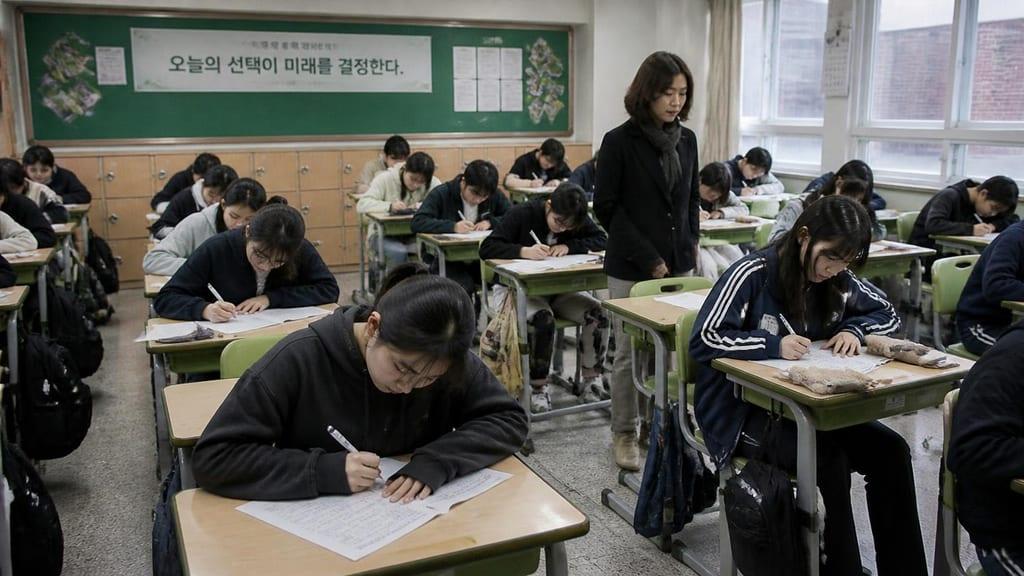
A high school in Yangcheon District, western Seoul, has ordered a whole year group to retake a graded writing assessment over suspicions that many students used AI to write their answers. The case, reported by Korea JoongAng Daily and The Asia Business Daily, shows how hard it is for schools to prove AI cheating, and who ends up paying for it.
What happened
If a student's writing suddenly becomes much more sophisticated, logically organized and grammatically polished than what we normally see, we start to suspect AI use
- The task was a Korean language and writing assessment on utilitarianism as discussed by Harvard professor Michael Sandel. Students typed their answers on devices in class, under a teacher's supervision, and submitted files.
- After tips from students, a teacher ran the answers through an AI-detection program. It flagged about 170 of roughly 240 students. (The Asia Business Daily puts the year group at 249.)
- The school asked those who had used AI to come forward. More than 10 students went to the teachers' office and admitted it.
- The school then decided everyone would retake the assessment, with changed questions, handwritten on paper. According to JoongAng Ilbo, the assessment is worth 50 of 100 points for the semester.
The numbers don't line up
The Seoul education office gave a smaller figure. It told The Asia Business Daily it had identified only a little over 10 cases of suspected AI use, and had not concluded that all of them cheated. It also explained why the school couldn't just hand out zeros: AI detectors can produce false positives, and formally treating a case as cheating needs more evidence, such as a written statement. Without proof of who used AI, the school chose a retake for everyone.
Students who did the work themselves say that's unfair. "It feels unfair that I also have to take it when I had actually studied hard and finished the assignment properly [without using AI]," some students said, according to Korea JoongAng Daily.
Smart glasses in the exam hall
Separately, South Korea's Ministry of Education checked all 5,679 middle and high schools and found four students who used AI-equipped smart glasses to cheat in midterm or final exams this year: one middle school student and three high school students, in Seoul, North Jeolla and Jeju. All four got zero on those exams. The high school students also faced three days of special education, four hours of community service and a five-day suspension, The Korea Times reported.
The stakes rise next week. According to The Korea Times, anyone caught using AI glasses in the national university entrance exam (CSAT) on November 19 will face criminal charges and a three-year ban from the test, up from one year.
Back to pen and paper
Teachers say they have no clear standard to go on. "If a student's writing suddenly becomes much more sophisticated, logically organized and grammatically polished than what we normally see, we start to suspect AI use," a teacher at another private high school in Seoul told Korea JoongAng Daily. More schools are returning to handwritten essays in class. Teachers call that the most reliable option, but it adds to their workload.
What students can take from this
AI detectors are not proof, and Korean education officials say so themselves. A detector score can still trigger a retake, an interview or an investigation, though. If you write your own work, keep your drafts and notes. They are the simplest evidence that the work is yours.
Sources
- Korea JoongAng Daily: Seoul high school orders all students to retake test over suspected AI use (koreajoongangdaily.com)
- The Asia Business Daily: More than 170 Seoul high school students suspected of AI cheating (asiae.co.kr)
- The Korea Times: 4 cheating cases using AI glasses caught at middle, high schools this year (koreatimes.co.kr)
- JoongAng Ilbo (Korean) (joongang.co.kr)
Source: koreajoongangdaily.com