Researcher says China's top AI models carry traces of banned Nvidia chips
Former OpenAI researcher Will DePue analysed the public weights of six models from DeepSeek, Moonshot, MiniMax and Ant Group. The traces match export-banned Blackwell chips, though that alone doesn't prove the law was broken.
In brief
Six Chinese AI models show traces of US-banned Nvidia chips, a researcher says
Former OpenAI researcher Will DePue analysed the public weights of six top Chinese AI models, including DeepSeek V4 and Kimi K3, and says he found traces of export-banned Nvidia Blackwell chips. The chips may sit in offshore data centres, so that alone doesn't prove any law was broken.
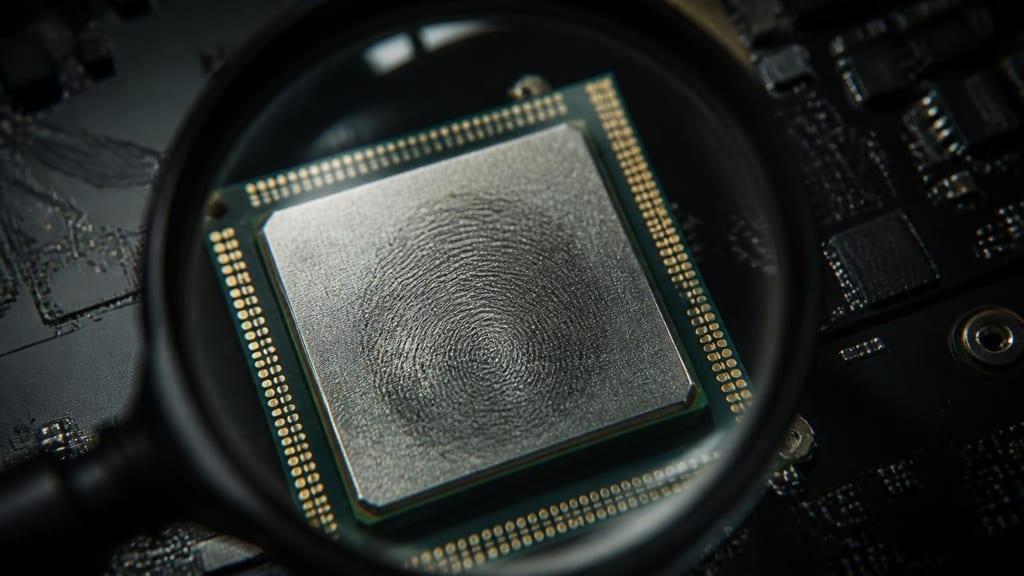
The most powerful open AI models from China were very likely set up on Nvidia chips that the US bans from export to China, according to an analysis released on November 12 by Will DePue, a former OpenAI researcher who leads the nonprofit research group Unemployment Labs.
The models named are DeepSeek-V4-Flash and DeepSeek-V4-Pro, Moonshot AI's Kimi K3 and Kimi K3.1-Pro, MiniMax-M3 and Ant Group's Ling-3.1-flash. All carry numerical traces that match Nvidia's Blackwell chips. Earlier models from the same companies matched Nvidia's older Hopper generation instead.
How a chip leaves a fingerprint
Before an AI model is trained, its billions of internal numbers (its "weights") are filled with random starting values. The way those values get laid out depends on how many processing units the chip runs in parallel, and Blackwell chips have a distinctive count. Some weights, such as those for rare symbols the model never sees in training, barely change afterwards and keep their starting pattern almost intact.
By reverse-engineering those patterns from the published weights, the analysis matched the six models to Blackwell configurations. For some models the researchers reproduced the match on real Blackwell hardware, according to summaries of the work. DePue estimates that Kimi K3 and DeepSeek-V4-Pro each used 2,000 to 3,000 Blackwell chips.
What it does and doesn't prove
The method shows where the models were started, and supports, without proving, that the same chips did the training. It also doesn't show that any law was broken. The chips could sit in an offshore data centre, a popular way for Chinese firms to get computing power. Research group Epoch AI estimates about 275,000 Nvidia AI accelerators were imported into Malaysia in 2024 and 2025, and about two million advanced chips entered China in those years through schemes that hid where they were going, TechCrunch reports. It also only works on models whose weights are public.
Why it lands now
Blackwell chips are banned from export to China and to Chinese-owned firms. The timing is awkward for Nvidia: its CEO Jensen Huang resigned this week after admitting an affair with Alice Huang, an executive at Megaspeed, a company linked to smuggling Nvidia chips into China and suspected by US officials of spying. White House adviser Michael Kratsios had already said earlier this year, citing intelligence sources, that Moonshot used export-banned Nvidia chips.
For readers who use DeepSeek or Kimi, nothing changes in the apps today. But the finding gives Washington a new, checkable tool, and more pressure to tighten who can use top chips, not just who owns them.
Sources
Source: techcrunch.com