GenFocal AI bridged the gap between global climate models and regional weather data
Researchers developed a machine learning framework to turn coarse climate projections into precise, localized weather information.
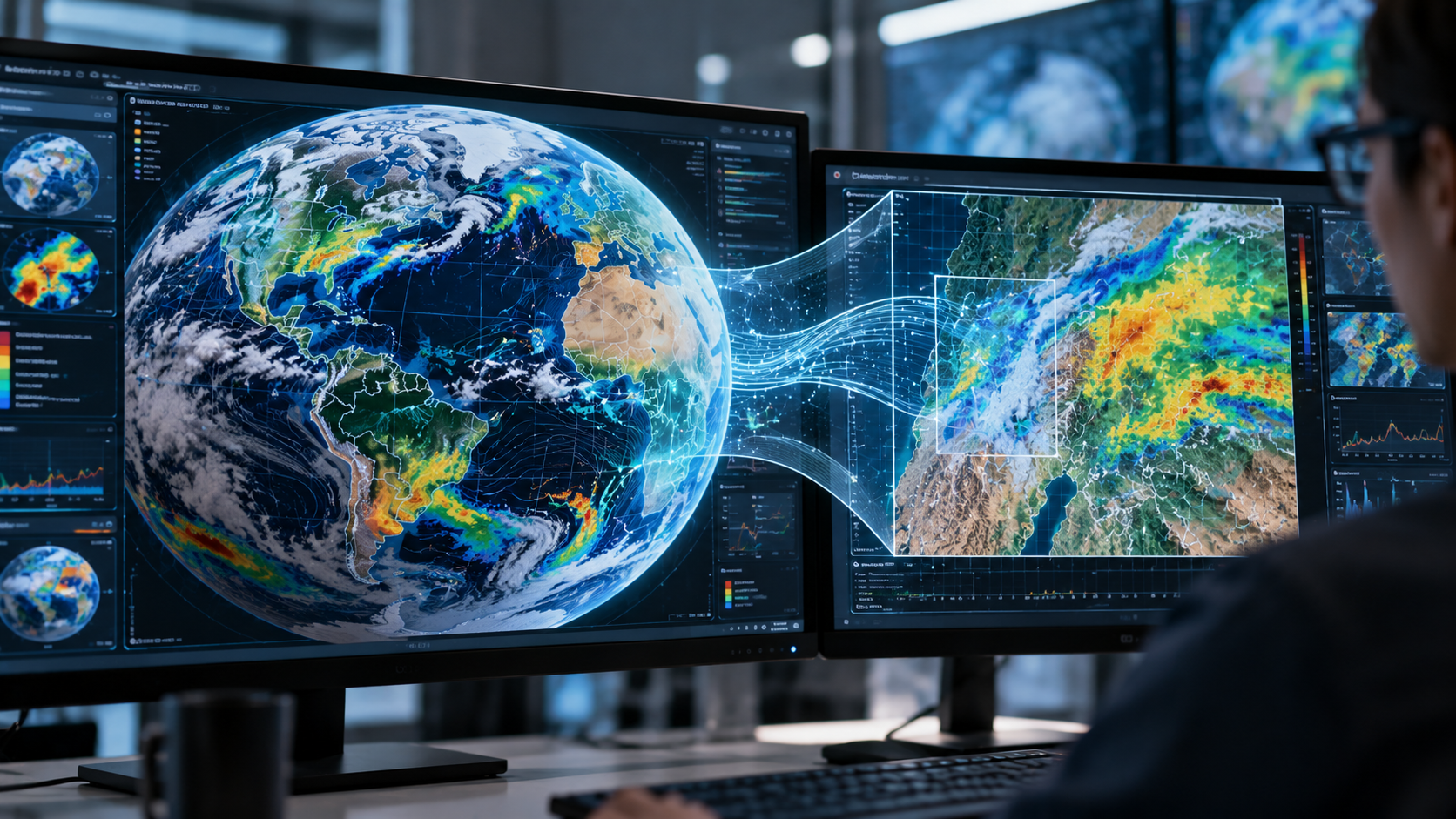
Scientists introduced GenFocal, an AI tool designed to translate broad, global climate data into specific, local weather patterns. This advancement aims to solve a long-standing issue where climate models were too coarse to help with regional planning, like preparing for floods or designing resilient infrastructure.
Global models provide broad trends but often miss the fine details of individual weather events. Traditionally, researchers used physics-based simulations, but these are computationally expensive and slow. Other statistical methods often failed to account for complex relationships between different weather variables.
GenFocal is a computationally efficient, general-purpose generative artificial intelligence (AI) framework that addresses this grand challenge.
GenFocal generates large sets of weather data that are consistent with global projections without needing pre-matched pairs of training data. This makes it easier to simulate rare and extreme events, such as heatwaves or tropical cyclones, which are typically hard for coarse models to resolve.
In testing, the model successfully simulated the full life cycle of tropical cyclones in the North Atlantic. It also improved the assessment of humid heatwaves in the United States by significantly reducing errors in predicting extreme temperature and humidity combinations.
- The framework models spatial and temporal connections to keep weather patterns coherent.
- It handles 10 daily input variables and produces 4 variables at a 2-hour interval.
- The AI is trained on historical data from 1980 to 1999 and evaluated on data through 2019.
Have you ever wondered how we might better prepare for local climate risks that global models simply cannot see? While promising, GenFocal was specifically tested on a chronological data split, and its performance depends on the accuracy of the underlying coarse climate projections it receives. The model does not replace global climate models; rather, it refines their output to create more actionable local insights.
Source: Nature Machine Intelligence