Google's new robot brain sorted car parts at Mercedes-Benz with 96% success
Gemini Robotics 2.5 handles chores its predecessor couldn't do at all, from hanging a cardigan to folding pants. Google hasn't said how long its factory test ran.
In brief
Google's Gemini Robotics 2.5 jumped from 0% to 93% at closing a toolbox
Google's Gemini Robotics 2.5 lets robots do chores the last version couldn't do at all, like hanging a cardigan. In a factory pilot on Mercedes-Benz lines, a humanoid sorted car parts with 96% success, though Google hasn't said how long the test ran.
Google DeepMind has released Gemini Robotics 2.5, the latest version of the AI model it builds to control robots. It is a vision-language-action model: it looks through the robot's cameras, understands an instruction in plain language and turns both into arm and hand movements.
The previous version, Gemini Robotics 2, came out in July. DeepMind tested the new one on more than 200 tasks, including serving food with tongs, tying bows on gift boxes and moving liquids with a pipette. Depending on the type of task, it succeeded 30% to 100% more often than before and finished 20% to 30% faster.
This is what we built Apollo for: useful work alongside people in real industrial settings.
From "can't" to "can"
The most striking numbers are for chores the older model could barely do, as published by DeepMind and collected by Humanoids Daily:
- Close the lid of a toolbox: 0% before, 93% now
- Untie a ribbon bow: 0% to 70%
- Hang a cardigan: 0% to 62%
- Sweep trash into a dustpan with a brush: 0% to 52%
- Fold pants: 0% to 40%
- Pack pastries with tongs: 5% to 100%
Forty percent on folding pants is not something you'd want in your laundry room yet. But going from zero to a working attempt in four months is fast progress.
The Mercedes-Benz test
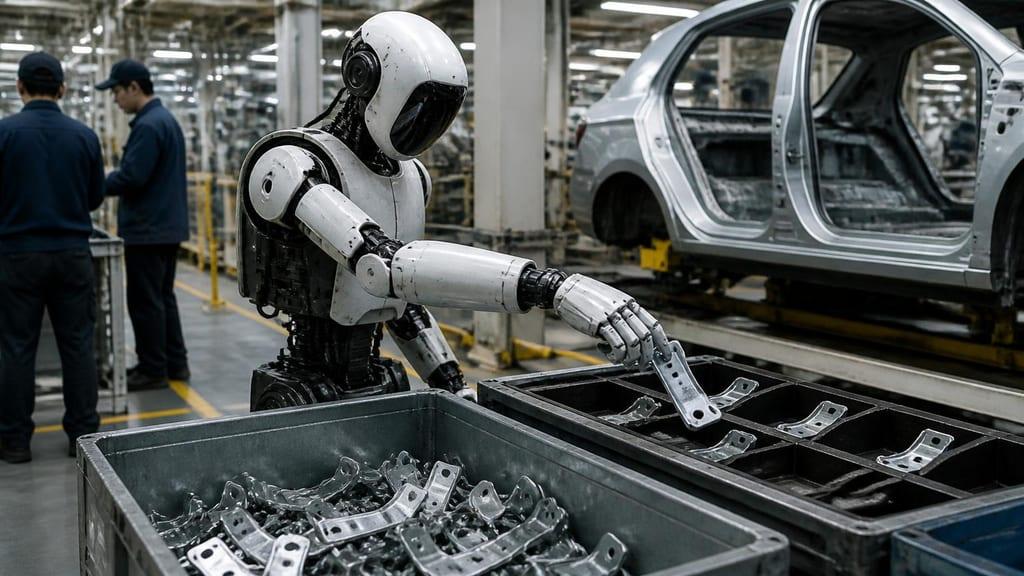
The headline result comes from real factories. DeepMind, robot maker Apptronik and Mercedes-Benz put Apptronik's Apollo 2 humanoid on active production lines in Kecskemét, Hungary, and Sindelfingen, Germany. The job was "kitting": picking metal brackets out of bulk bins and placing them into trays in the exact order each car on the line needs them.
Two models split the work. Gemini Robotics ER kept track of the workflow, and Gemini Robotics 2.5 controlled the hands and arms, correcting itself when a grasp or placement went wrong. DeepMind reports a 96% success rate.
This is what we built Apollo for: useful work alongside people in real industrial settings.
That was Apptronik co-founder and chief executive Jeff Cardenas. He added that the models improved a lot within a few weeks of extra training and carried over to the Mercedes lines with very little drop in performance.
What we don't know
DeepMind calls the factory work a proof of concept. As Humanoids Daily points out, it does not say how many picks the 96% covers, how long the pilot ran, or how the robot's speed compared with a human worker's. On a production line, the remaining 4% matters: someone still has to catch and fix each miss.
DeepMind also says this is the first Gemini Robotics model whose development was helped by Argon, a system that runs simulated practice and studies failures. It doesn't say how much of the gain came from that.
Who gets it
The model is rolling out to DeepMind's robotics partners, including Agile Robots, Apptronik and Mercedes-Benz. It is not something you can download for a home robot. For factory workers, the pitch is that robots take the repetitive, physically tiring prep work, and technicians move to the more complex build tasks.
Sources
- Google DeepMind: Gemini Robotics 2.5 (deepmind.google)
- Humanoids Daily: Gemini Robotics 2.5 puts Apollo 2 on Mercedes-Benz lines (humanoidsdaily.com)
- The Decoder: Gemini Robotics 2.5 scores 96 percent in a Mercedes-Benz pilot (the-decoder.com)
- Interesting Engineering: Gemini Robotics 2.5 factory trial (interestingengineering.com)
Source: deepmind.google