METR says AI's task length doubles every 3.6 months, but judgment still lags
The nonprofit warns that public evidence cannot rule out a drastic speed-up in AI research, while models still trail experts when there is no clear signal of success.
In brief
METR: AI task length doubles every 3.6 months
The AI testing group METR says the length of tasks AI models can finish is doubling roughly every 3.6 months, which naively points to 200-hour tasks by July 2027. It warns that current evidence cannot rule out a drastic speed-up in AI research.
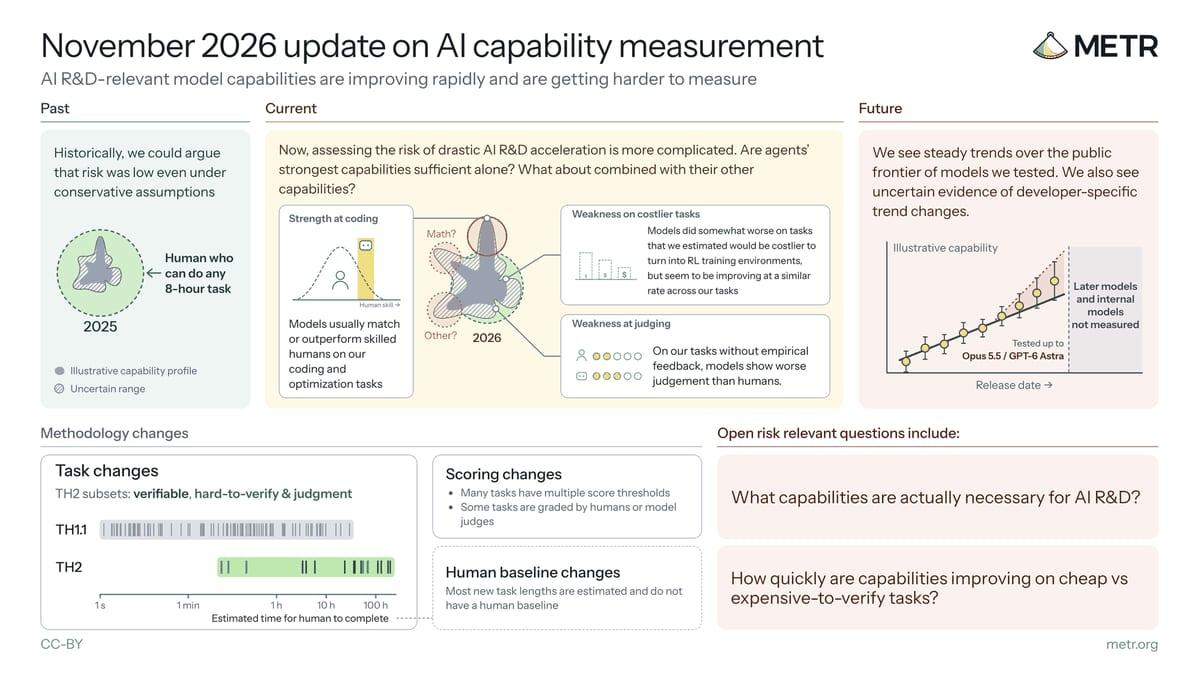
The length of tasks AI models can finish is still doubling roughly every 3.6 months, according to METR, a nonprofit that tests AI systems. In a report published on November 20, 2026, the group warns that current public evidence cannot rule out a drastic speed-up in AI research within the next couple of years, even though models still trail human experts on tasks that need judgment.
The report covers public models up to Anthropic's Claude Opus 5.5 and OpenAI's GPT-6 Astra.
Ultimately, I don't think we'll be able to establish trends as clean and robust as for the easy-to-specify [tasks].
What is a "time horizon"?
METR measures AI ability in human working time rather than test scores. It takes real coding and research tasks, estimates how long a skilled professional needs for each one, and then asks: what is the longest task a model completes successfully at least half the time? That length is the model's time horizon. A model with a two-hour horizon succeeds on about half of the tasks that take a person two hours.
It does not mean the model works for two hours. It is a way of describing how hard a task is, in units anyone can picture. MIT Technology Review calls the original chart "the most misunderstood graph in AI"; it showed horizons doubling about every four months.
The new numbers
| Measure | METR's finding |
|---|---|
| Doubling time, TH1.1 and TH2 task sets combined | 3.61 months (about 110 days), 95% range 2.08 to 4.94 months |
| Earlier trend, TH1.1 alone | 105 days |
| Doubling time, verifiable TH2 tasks only | 1.65 months (noisy data) |
| OpenAI's internal research tasks, per OpenAI data | about 3.8 months |
| Naive extrapolation to 200-hour tasks | July 2027 |
A 200-hour task is roughly five weeks of full-time work. METR calls the July 2027 date a "naive extrapolation", and 200 hours is simply the longest threshold in its task set, not a ceiling on what AI could do.
The faster doubling on easy-to-check tasks could be a sign of acceleration in 2026, the report says. It could also come from those tasks being similar to one another, or from the shorter period the data covers. METR says plainly that it does not know which.
Where models win, and where they stumble
On coding and optimisation tasks with a clear target, models usually match or beat skilled humans. When METR recruited people to set human benchmarks, it typically failed to find anyone who outperformed the best current models. Where 10 or more specialists had tried the same task, models placed at a very high percentile, but not at the very top.
The picture changes when there is no quick signal of success. On tasks that require choices without clear feedback, AI agents appear to have worse judgment than human experts, METR found. In one task, models acting as judges overrated work produced by models as strong as or stronger than themselves. Put simply, they grade their peers too kindly.
MIT Technology Review adds that when METR asked models to design new AI evaluations, none was good enough for its staff to use. Newer models such as Opus 5.5 came close, though; a year earlier every model was clearly below the bar.
Why METR is worried
METR's concern is what it calls drastic AI R&D acceleration: "a situation where capabilities improve so quickly that humans are no longer able to meaningfully understand, assess, and react to catastrophic risks posed by new AI systems."
In the past, the group says, it could argue that risk was low because models clearly failed at things that were easy to measure. Models are now very strong on well-defined coding, cyber and machine learning problems, so that reassurance is harder to give. The trends also leave out unreleased internal models, which METR says could be "far beyond the current frontier."
On the other side of the ledger, its composite capability index shows no strong acceleration across public frontier models, only uncertain signs of changes at some individual developers.
The new figures have weak spots. Most new task lengths are estimates rather than timed human attempts, and judgment tasks are few. In a philosophy-argument task, one person rated most of the arguments, MIT Technology Review reported. Matt Putz of METR told the magazine: "Ultimately, I don't think we'll be able to establish trends as clean and robust as for the easy-to-specify [tasks]."
What it means for you
If you use AI at work, the report draws a practical line. Today's models are excellent when the goal is clear and the result can be checked, such as code that passes its tests. They are less reliable when the job is judging the quality of something whose results show up later, like picking a research direction or assessing a plan. Keep a person on those calls.
The finding about models grading their peers is worth remembering too: if you ask one AI assistant to review another's work, do not treat its praise as proof of quality.
As for when machines start speeding up their own development, this report does not answer that, and does not claim to. What it says is that the measuring tools are falling behind, which is news in itself.
Sources
- AI R&D-relevant model capabilities are improving rapidly and are getting harder to measure (METR, November 20, 2026) (metr.org)
- The most misunderstood graph in AI just got a major update (MIT Technology Review) (technologyreview.com)
- AI is getting better faster than experts can reliably test whether new systems are safe, METR warns (The Decoder) (the-decoder.com)
Source: metr.org