Abu Dhabi's MBZUAI gives away PAN 2, an AI that shows what an action will cause
PAN 2 turns a scene and a written action into a short video of the likely outcome, so robots and AI agents can test a move before making it. The weights and the full training code are free under Apache 2.0.
In brief
A free AI model from Abu Dhabi's MBZUAI lets robots test a move before making it
Abu Dhabi's Mohamed bin Zayed University (MBZUAI) released PAN 2, an AI that turns a scene and a written action into a short video of the likely outcome, so robots can test a move first. It ranks first among open models on one physics leaderboard, and its weights and full training code are free.
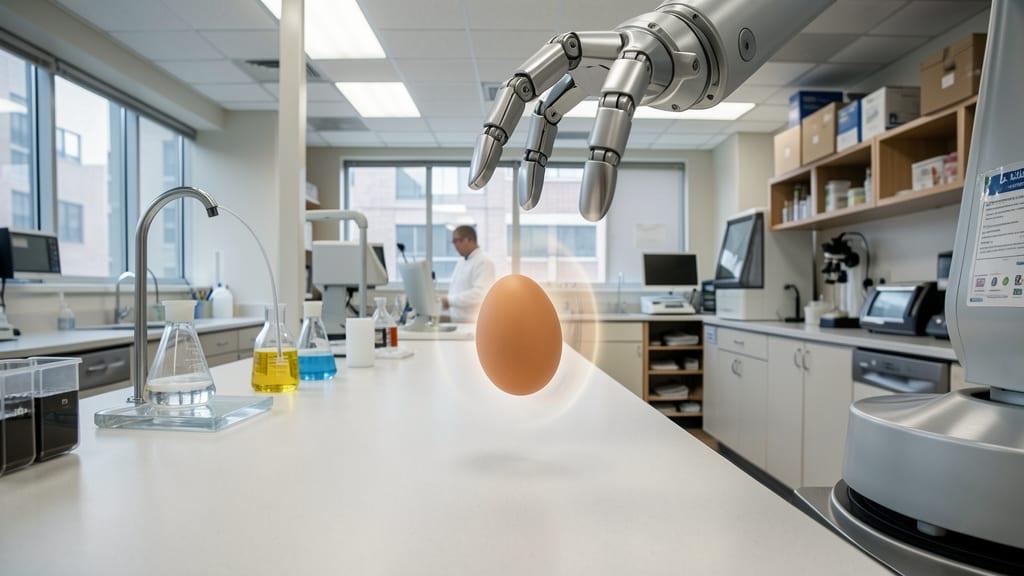
A chatbot predicts the next word. PAN 2 tries to predict the next moment of the physical world.
The Institute of Foundation Models (IFM), the research lab set up by Abu Dhabi's Mohamed bin Zayed University of Artificial Intelligence (MBZUAI), released PAN 2 this week. You give it a starting scene and an action written in plain words, and it produces a video of what is likely to happen next: how a wave breaks, how a hand grips a pipette, what an egg does when it hits a hard floor.
We want researchers to be able to test PAN 2's capabilities, understand its limits, and build on it
IFM calls this "simulative reasoning". The idea is simple: an AI agent or a robot can ask "what happens if I do this?" and look at the answer before it touches anything real, instead of learning through costly, slow or irreversible trial and error.
Two models working together
PAN 2 is built from two parts:
- A language model works out what happens and when, and writes a time-stamped description of the events, the actions and the camera movement.
- A video model (a 29-billion-parameter diffusion model that IFM trained from scratch) turns that description into moving pictures. IFM says it picked training videos for their physical dynamics, not for how pretty they look.
It sits on an architecture called Generative Latent Prediction, developed by MBZUAI president Eric Xing and IFM researchers, which predicts changes inside an internal picture of the world and then rebuilds what a camera would see. That makes the predictions checkable against real footage.
How good is it?
By IFM's own numbers:
- On six core tests of physical intelligence (physical consistency, cause and effect, objects staying the same, respecting constraints, viewpoint changes and motion), PAN 2 came second, just behind MiniMax-H3 and ahead of four other models.
- In multi-step planning, it completed more full plans than any other model tested.
- On the public Physics-IQ Verified leaderboard it ranks third overall and first among open-weight models.
IFM also admits the main weakness: keeping a simulated world consistent over long stretches "remains an open challenge".
Open, including the part most labs keep
The release includes the video model weights, the full training and inference code, documentation and a technical blog, all under the Apache 2.0 licence, which allows commercial use. Very few world models ship with their training code.
"We want researchers to be able to test PAN 2's capabilities, understand its limits, and build on it," said Hector Liu, director of IFM's Silicon Valley lab.
What it means for you
This is a research tool, not a phone app. Its first users will be robotics teams, labs and universities that want a cheap place to rehearse a robot's moves. For the Arab world, the more interesting part is who built it: IFM runs labs in Abu Dhabi, Silicon Valley and Paris, and its earlier work includes the Arabic language model Jais and the open K2 models. A Gulf lab publishing a competitive world model with everything needed to rebuild it gives regional students and startups something real to study and build on.
Sources
Source: ifm.ai