Z.ai says its new GLM-5.4 matches models three times its size by looping layers
The Chinese model is available to coding-plan subscribers now, but Z.ai has not yet published benchmark scores for the full-size version.
In brief
Z.ai's GLM-5.4 runs its layers twice to rival far bigger models
Chinese lab Z.ai released GLM-5.4 on November 23, 2026, a 750-billion-parameter model that runs 28 of its layers twice. Z.ai says it matches models of 2 to 3 trillion parameters, but has published no benchmark scores for it yet.
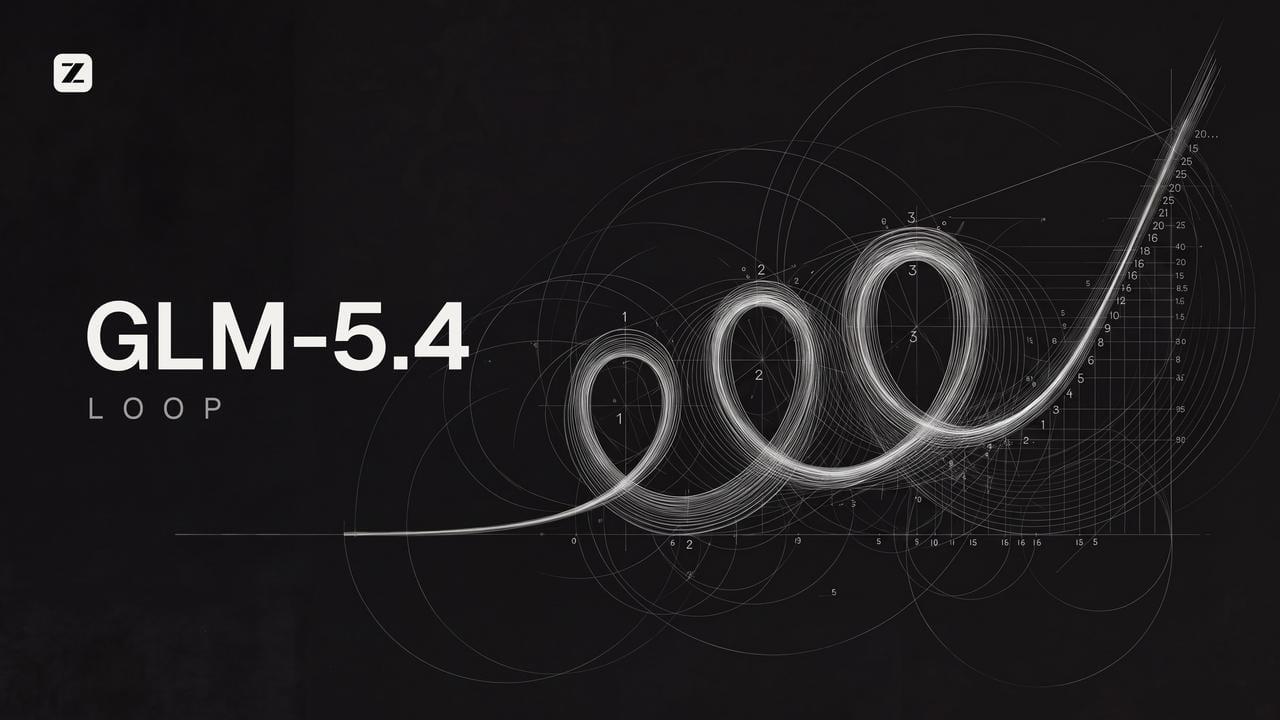
Instead of building a bigger model, Chinese AI lab Z.ai has made its new one think twice. On November 23, 2026, the company, also known as Zhipu AI, released GLM-5.4, a model of about 750 billion parameters that runs 28 of its layers twice on every pass. Z.ai says that lifts it to the level of models with 2 to 3 trillion parameters.
GLM-5.4 is available now to subscribers of Z.ai's GLM Coding Plan, in its ZCode coding environment and in Z.ai Chat, according to the company's technical blog. Access for developers through an API (the interface apps use to call the model) will follow a safety evaluation, and Z.ai says it will release the model weights "responsibly" after further safety hardening.
What is a loop transformer?
In a standard language model, each layer runs once per pass. In a loop transformer, a group of shared layers runs more than once, refining what the previous pass produced. You get a deeper network without adding parameters, and so without a heavier model to store. Think of a student who checks their answer a second time instead of memorising an extra textbook.
The idea dates back to the Universal Transformer of 2018, Z.ai notes. But it says loop models trained from scratch still trail normal models on the same compute budget, so it took its already trained GLM-5 base model and converted it through continued training. The Decoder reports that OpenAI has used a similar architecture since GPT-6 Astra.
To stop the second pass from doubling memory use, the model reuses the first pass's memory of earlier text and keeps only a small extra window of its own. Z.ai says GLM-5.4 reaches up to 200 tokens per second off-peak and 70 to 80 at peak load. Its documentation lists a context window of 1 million tokens, with text, image, video and file input.
What is the evidence it works?
Here is the fine print: Z.ai has published no benchmark scores for the 750-billion-parameter model itself. The figures it shared come from a 30-billion-parameter test model, where a looped version was compared with a normal one of the same size, using about 10% more training compute. The Decoder reported these results:
| Test (30B model) | Normal version | Looped version |
|---|---|---|
| AIME25 (maths) | 19.2 | 30.4 |
| GPQA-Diamond (expert science) | 47.6 | 56.3 |
| AA-LCR (long context) | 40.3 | 47.7 |
Answers also got shorter. Z.ai says average output length fell by 10% to 14% on tests such as GPQA-Diamond and MMLU-Pro, because part of the reasoning moved out of the written text and into the extra depth of the loop. There are no independent evaluations yet, The Decoder notes.
Z.ai is open about one weakness: the model sometimes gets caught in overly long "marathon thinking" loops, though the company says the extra self-checking does improve accuracy. A model built on going round in circles occasionally goes round in circles; at least the company says so itself.
Coding beyond code
Z.ai pitches GLM-5.4 as the start of "Generalized Coding", using code as the base for tasks well beyond software. Its demos include:
- a self-narrated music video called "Hello World";
- a six-axis robotic arm designed in the engineering CAD program FreeCAD;
- a complete game with movement, physics, maps and combat;
- an interactive 3D bird-watching scene built from mathematical geometry and custom shaders.
These are showcase pieces the company chose, not independent tests.
What it means for you
If you are a developer on the GLM Coding Plan, you can use it now, and Z.ai says users with weekly quotas get 1.5 times the allowance they had with GLM-5.3. If you were waiting for open weights to run it yourself, there is no date. The Decoder notes Z.ai also delayed the weights of GLM-5.3 because of its strong ability to find security vulnerabilities.
For everyone else, the direction matters more than the model. AI labs are looking for more intelligence without ever-larger, ever-costlier models. If Z.ai's claim holds, that could mean stronger open models that are cheaper to run. Until scores for the full model and outside tests appear, it remains the company's claim. Z.ai says a "significantly larger" model is coming soon.
Sources
- GLM-5.4: Toward Generalized Coding with Our First Loop Transformer (Z.ai) (z.ai)
- GLM-5.4 model documentation (Zhipu BigModel) (docs.bigmodel.cn)
- Z.ai follows OpenAI into loop transformer territory with its new 750B flagship model (The Decoder) (the-decoder.com)
- Z.ai's GLM-5.4 runs its layers twice to rival 2T-parameter models (The Next Web) (thenextweb.com)
Source: z.ai