PAIR framework helped robots improve task success rates by up to 13.6 percent
A new method connects how robots perceive visual instructions with the actions they perform to complete physical tasks.
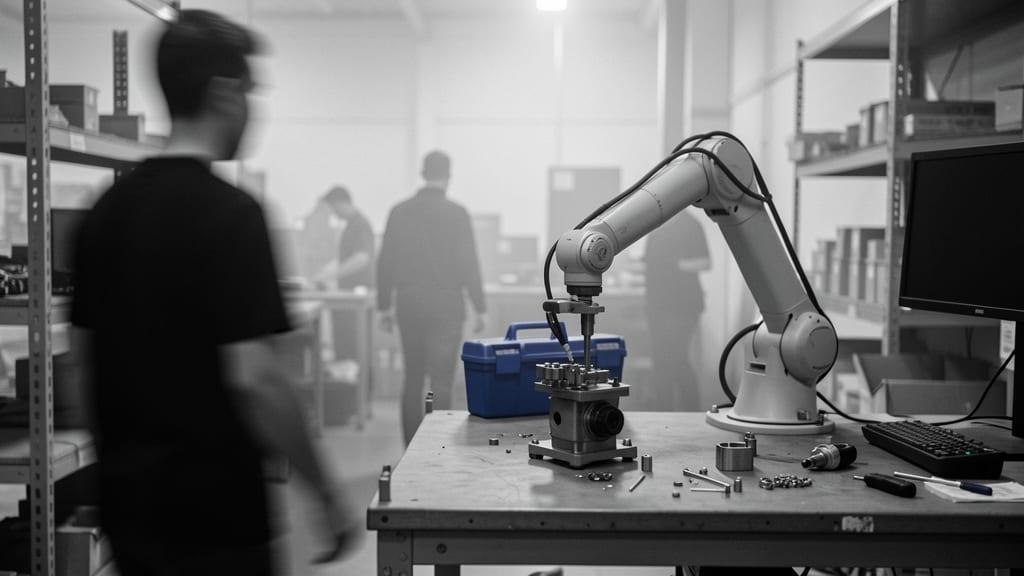
Vision-language-action (VLA) models allow robots to see their surroundings and follow spoken or written instructions. However, these systems often struggle to turn what they see into precise physical movements. A new technique called PAIR helps bridge this gap by creating a shared space for perception and action.
Most robots currently process vision and language separately from their physical moves. They essentially guess the best action after analyzing the scene. PAIR changes this by introducing a bridge that aligns visual data directly with the structure of expert robot movements.
These results support a shared intermediate representation as a useful interface between perception and action in continuous-action VLAs.
During training, the system uses a Masked Action Autoencoder to learn from expert demonstrations. It encodes these movements into specific tokens. A bridge module then extracts relevant information from what the robot sees and links it to these action-ready tokens.
Imagine you ask a robot to stack blocks on a table. Instead of just trying to calculate the final action at the last second, the robot uses these bridge tokens to understand the sequence of motions needed to grab and place the blocks effectively.
Tests on various systems like OpenVLA-OFT and VLA-Adapter showed significant improvements in performance across different environments. On the LIBERO-Plus benchmark, the success rate climbed from 59.1 percent to 64.2 percent. In real-world tasks, OpenVLA-OFT improved its success rate from 51.4 percent to 65.0 percent.
Does this mean robots will finally stop knocking over the kitchenware? It is a promising step for consistency, but researchers note that PAIR currently relies on the presence of high-quality expert training data to function correctly. The framework was only tested on specific benchmarks like CALVIN and LIBERO, meaning its performance in unpredictable, cluttered home environments remains to be seen.
Source: arXiv cs.AI