Researchers split robotic navigation tasks into two floor levels to improve success
A new diagnostic study suggests that dividing navigation policies into floor-specific modules helps robots better handle complex, multi-story buildings.
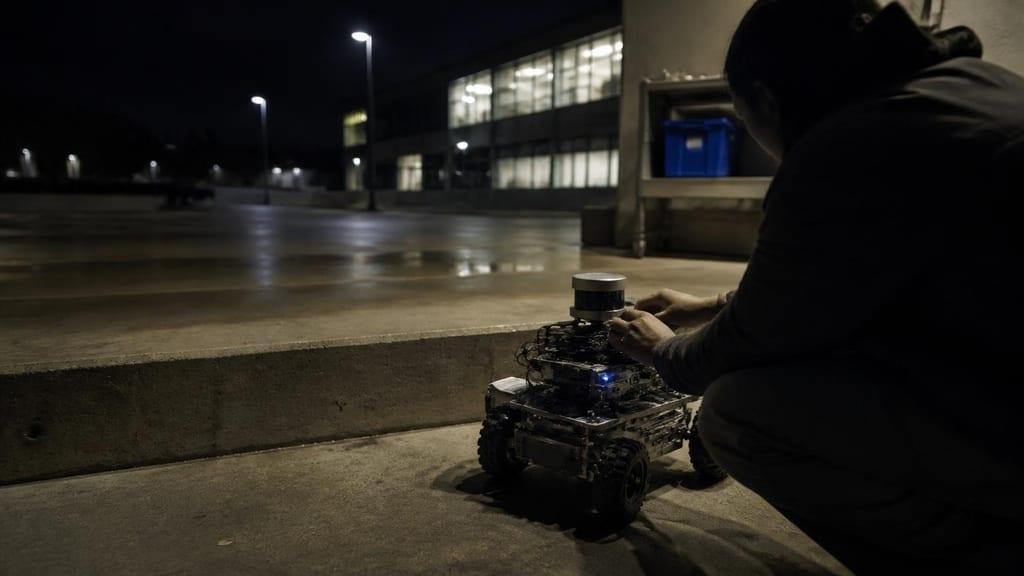
Navigating a multi-story building is tough for robots. They often get lost or fail because the task involves too many steps at once, leading to sparse rewards. A recent paper published on arXiv proposes a solution by breaking down the decision-making process into two parts: moving within a floor and moving between floors.
The modular approach
Experiment results indicate that perception performance and stair climbing stability are the primary bottlenecks in multi-floor navigation.
Instead of using one massive brain for the entire navigation task, the researchers created a hierarchical system. One module handles exploration within a single floor, while another focuses specifically on switching floors. By teaching the robot to think in these chunks, it avoids the confusion of trying to map an entire building in one go.
To give the system a head start, the team used Visual Language Models (VLMs) to train the intra-floor module. This approach allows the robot to learn basic exploration patterns more efficiently before it even tries to climb a set of stairs.
Identifying the bottlenecks
Through this diagnostic study, the researchers found that their factorized policy works just as well as a single, complex policy in theory. However, the real-world results highlighted two main trouble spots. Robots still struggle with basic perception—correctly identifying where they are—and maintaining stability while navigating stairs.
Imagine you ask a delivery robot to find a package on the third floor of an office building. It seems easy to a human, but for the machine, it is a series of complex transitions. Do you think robots will eventually master the art of climbing stairs without human supervision?
Source: arXiv cs.RO