Researchers trained microrobots to navigate complex environments in under 10 minutes
A new machine learning framework uses vectorized simulation to drastically shorten the design and training cycle for autonomous medical microrobots.
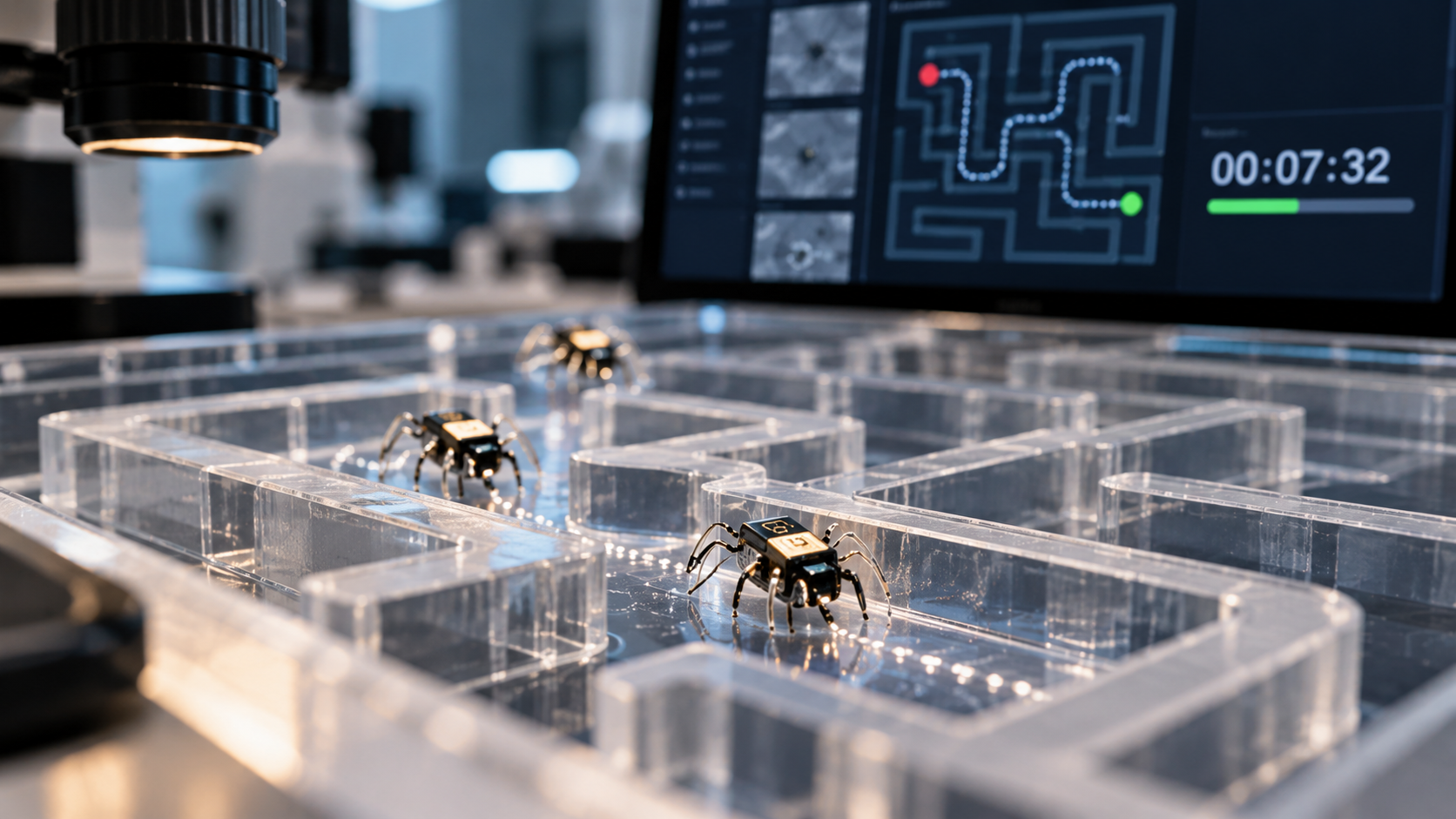
Scientists have developed a new way to train autonomous microrobots, cutting the required time from days to just under 10 minutes. This advance, detailed in a recent Nature Machine Intelligence paper, aims to speed up how we deploy tiny machines for medical tasks like targeted drug delivery.
The team built a fully vectorized simulator that acts as a digital playground. It contains over 10,000 different artificial vascular environments. By running these scenarios in parallel, the system can process roughly 190,000 movements every second.
The proposed learning framework reduces training time to under 10 minutes, while supporting zero-shot deployment across distinct microrobot types.
To make this training effective, they introduced a reward system called task-shaping-regularization. This method helps the AI learn faster while making fewer erratic movements. It also improved the ability of these robots to avoid obstacles by at least 2.1%.
Another advantage is the ability of these trained policies to work across different robot types without needing further adjustments. This is known as zero-shot deployment, meaning the model is ready to go as soon as it is finished.
Imagine you need a team of tiny robots to navigate a complex blood vessel network to deliver medicine. Previously, preparing the AI brain for these robots would take a long time, slowing down research. Now, that bottleneck is significantly smaller.
Could this speed turn microrobots into standard tools in our clinics sooner than expected?
This framework relies on simulated environments to build its navigation skills. It does not account for all potential real-world complications that might exist inside a human body, such as unpredictable fluid dynamics or extreme biological variables that were not captured in the 10,000 virtual environments used for the study.
Source: Nature Machine Intelligence