Cloth showed 10 different outcomes from the same robot move
The team ran the same fast cloth motion 10 times across 4 tasks and found large variation that simulators could not match.
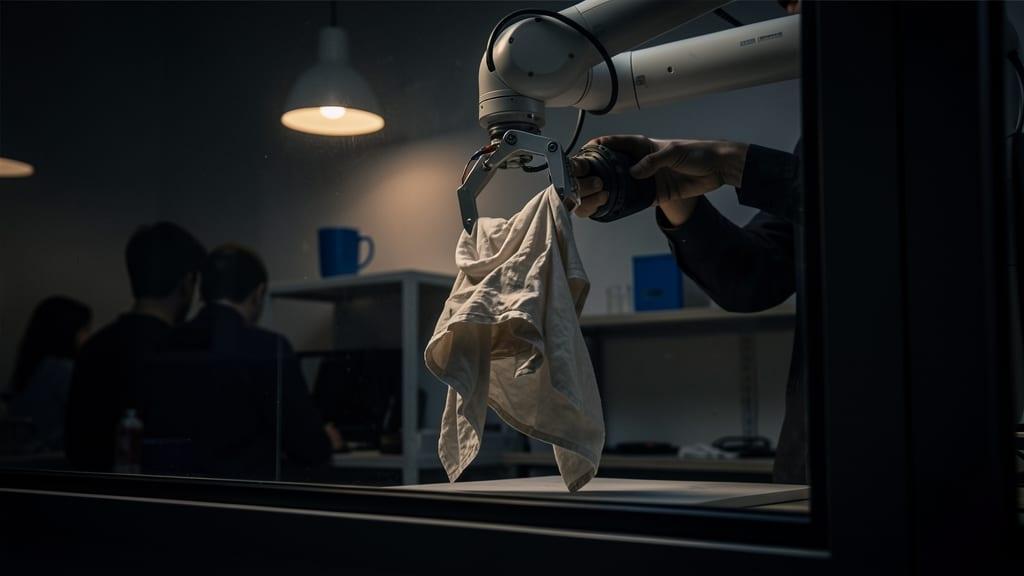
A cloth can behave differently even when a robot repeats the same fast move exactly. That is the main result from a robotics paper released today.
The team tested the same trajectory 10 times across 4 dynamic cloth tasks. Two of those tasks were new. They used 3 cloths with very different physical properties.
Variability was significant in every test condition.
They also changed the execution speed, with up to 3 speeds in the tests. In total, the dataset contains 269 rollouts, which are recorded runs of the robot doing the task.
To measure what changed, the setup recorded small markers on the cloth and a synchronized stereo camera. The team then built metrics to quantify how much the outcomes drifted from run to run.
The answer was not subtle. Variability showed up in every test condition. In most cases, it was 1 to 3 orders of magnitude above the repeatability limit from robot and sensing noise.
The cloth itself mattered most. Speed also made the spread larger. So if you imagine asking a robot to fold or fling a soft sheet the same way twice, the cloth may still decide to improvise.
The team replayed all the runs in 4 calibrated modern cloth simulators. None of them matched the size of the variation seen in real cloth, and none matched the order of the results either.
The paper comes with a dataset that includes synchronized OptiTrack, vision and robot logs, plus simulator twins for the recorded runs.
What it does not show is a simulator that can yet reproduce real cloth variability at the level seen in the lab, or cover every possible cloth behavior beyond the 4 tested tasks and 3 cloth types.
Source: arXiv cs.RO