New robotics navigation system processes event camera data in real time
Researchers developed a method that uses event cameras to navigate robots with significantly higher precision than traditional estimators.
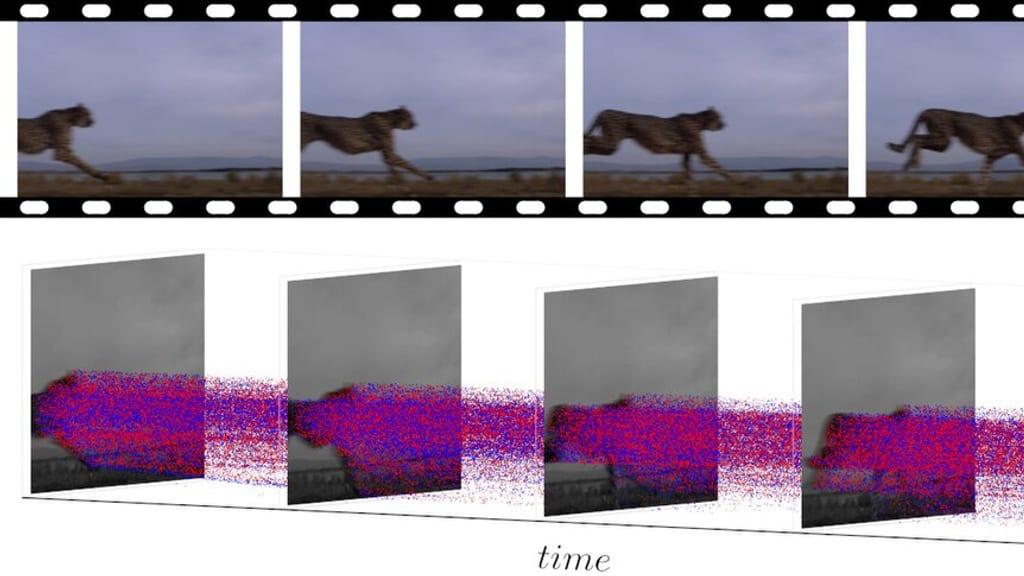
Researchers recently published a paper demonstrating a new way for robots to see the world using event cameras. Unlike standard cameras that capture full frames, event cameras record changes in light at a microsecond level. This makes them much more capable during fast motion or challenging lighting conditions.
The challenge with event cameras is that they produce massive amounts of asynchronous data. Processing this continuously usually requires too much computing power. This new system solves the problem by focusing on specific points in time called keytimes. It uses a mathematical approach known as Gaussian process regression to fill in the gaps between these points.
It effectively allows machines to react to their environment with the speed of a nervous system rather than a slow camera shutter.
The team tested their pipeline against a standard estimator called ES-PTAM. On the MVSEC and DSEC datasets, their method proved far more accurate. It achieved relative position errors as low as 0.46 cm and rotation errors of 0.038 degrees. These results were up to 15 times better than the existing technology in certain scenarios.
Imagine a drone flying through a dark room. Instead of struggling with blurry images, the robot uses the precise timing of light changes to keep its balance and position. It effectively allows machines to react to their environment with the speed of a nervous system rather than a slow camera shutter.
While this method shows significant promise for mobile robotics, it has not yet been tested in every possible environment. The researchers noted that their performance metrics were measured specifically on established datasets, so real-world unpredictable conditions remain to be fully validated in practice.
Source: arXiv cs.RO