PanTact taught a humanoid to use its whole body for contact tasks
The system learned from robot-free human demos and then ran on a Unitree G1 without extra body contact sensors.
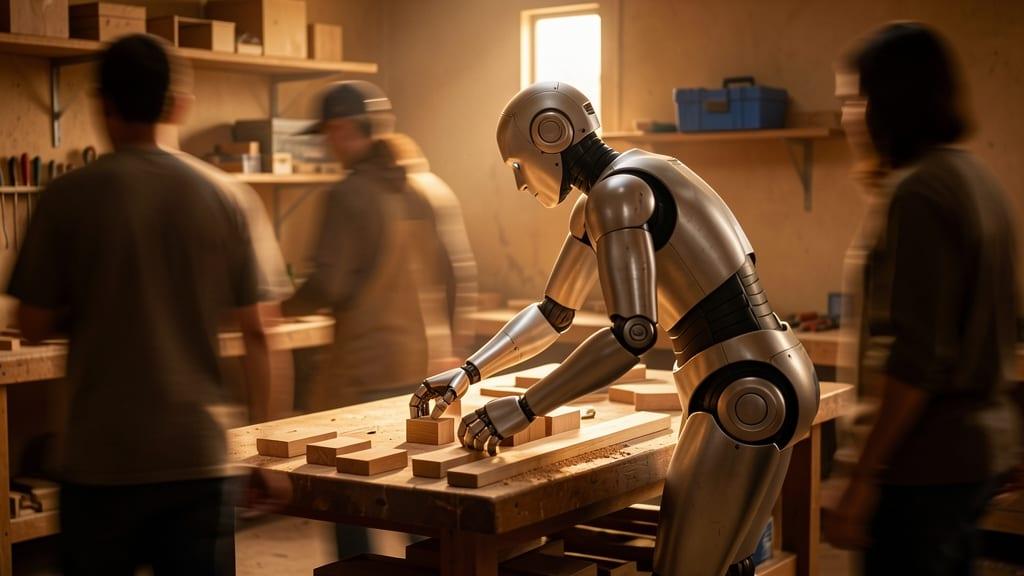
PanTact taught a humanoid robot to use more than its hands. The work comes from an arXiv paper in cs.RO published on 2026-10-12.
The idea is simple: use contact itself as the clue. If a task needs a shoulder brace, a push, or a body lean, the system tries to learn that contact pattern instead of treating the hands as the only useful tools.
The system treats contact as part of the task, not as an afterthought.
To collect the training data, PanTact uses a wearable interface for human demonstrations. It combines egocentric vision, bimanual UMI grippers, and modular contact patches that record where the body touched and when.
That data feeds a visuomotor policy, which is a model that turns what the robot sees into actions. It is meant to bridge the gap between a person’s view and what the robot can observe from its own cameras.
PanTact then predicts whole-body contact goals and turns them into control commands. In plain terms, the robot decides which surface should touch what, and then figures out how to arrange its body to do it.
The paper says the system was deployed on a Unitree G1 humanoid without extra body contact sensors.
In those tests, the robot handled body support, pushing, sweeping, and load-sharing. That is a wider toolbox than the usual hand-only setup.
The interesting part is not that the robot has more limbs. It is that the software treats contact as part of the task, not as an afterthought. Ever watched a robot act like it forgot it has elbows?
The source does not report broad benchmark numbers, and it does not show that the method was tested on other robots beyond the Unitree G1.
Source: arXiv cs.RO